Archive
Getting started with #ProjectOnline Part 1 #PS2013 #Office365 #Project #PPM #SharePointOnline #PM
|
I am a Project Server and SharePoint consultant but my main focus currently is around Project Server.
I have been working with Project Server for nearly five years since 2007 for a Microsoft Gold Certified Partner in the UK, I have also been awared with the Microsoft Community Contributor Award 2011. I am also a certified Prince2 Practitioner. This article has been cross posted from pwmather.wordpress.com (original article) |
This post is the first post from a series of posts I am going to write based on Project Online. It is very simple to get a Project Online Office 365 tenant but once the PWA site collection is there, what next? Where do you start? How do you get the most out of it? This series of posts will guide you through these steps so that hopefully you get the most out of Project Online.
Firstly I will go through creating the PWA site collection, for this you will need tenant admin access as this is created from the SharePoint Admin site on the Office 365 Admin center.
From the Office 365 Admin site below:
Click Admin > SharePoint:
On this page you can manage all the SharePoint related functionality:
As you can see, there is already one PWA site collection on this tenant, you can have up to 3 per tenant. To create a new PWA site collection click New > Private Site Collection with Project Web App
This will load a form, the completed form can be seen below:
Click OK. You will now see the new PWA site collection appear but with a spinning circle that states “The site collection is being created.”
After approximately 10 to 15 minutes the PWA site collection will be ready and accessible, notice the NEW text in green:
Clicking the new PWA site link will load the site collection properties:
Click the Site Address and the PWA site will load:
There it is, in a handful of steps you now have a fully functioning Project Online PWA site collection.
Next up we will begin configuring and customising the Project Online site collection.

#SSRS native report render issue in #SharePoint #SP2013 with #IE 9 or later #PS2013 #BI #SQL
|
I am a Project Server and SharePoint consultant but my main focus currently is around Project Server.
I have been working with Project Server for nearly five years since 2007 for a Microsoft Gold Certified Partner in the UK, I have also been awared with the Microsoft Community Contributor Award 2011. I am also a certified Prince2 Practitioner. This article has been cross posted from pwmather.wordpress.com (original article) |
This post covers an the details around an issue I came across the other day and I wanted to make you aware to help in your deployments / system design. The issue is with displaying SSRS Native mode reports on a SharePoint 2013 page using a page viewer web part when using IE 9 or later. Our preference and recommendation is to usually use SSRS Integrated mode but on occasions some of our clients use SSRS Native mode. This issue doesn’t exist for SSRS Integrated mode.
The is that the SSRS reports are not displayed correctly on the page, they are truncated:
Other standards-compliant browsers are ok, Chrome is:
IE 8 also works fine.
The page viewer web part with SSRS Native reports worked fine in SharePoint 2010 in any browser.
I have tested with the SSRS Report viewer web part (the 2008 R2 version as the SQL 2012 version doesn’t deploy to SharePoint 2013) from the RSWebParts.cab file, this has the same issue.
One of our devs had a quick look at this and it stated it was because the web part uses a table that is 3 cells wide. 2 of the cells are related to the document map while the 3rd contains the report itself. The document map cells are hidden by default.
In older versions of IE, a hidden cell in a table counted towards with width of the table, this was against the standard. Now with more standards compliant browsers, hidden cells do not count towards the width of the table.
This means that the report cell is the only cell defined for the row, so the browser forces it into the left most cell space. The end result of this is the SSRS report is truncated to the right as that is the limit of the size of that column.
So the answer going forward if your client wants to embed SSRS reports in SharePoint 2013 pages and they use IE, recommend (and use) SSRS 2012 Integrated mode.
Updating database collation
Had some fun trying to update a database collation. I didn’t have to worry about the data i just needed to the collation changed so that some cross database scripts would still function in order to carry out some testing.
Here is a nice little script I found that will generate scripts to change the collation on the required columns. Some of it fails if primary keys or indexes are against the columns but this will do 90%.
SELECT
CAST(o.table_name + ‘ -> ‘ + c.name AS VARCHAR(60))
, ‘ALTER TABLE ‘ + o.table_name +
‘ ALTER COLUMN [‘ + c.name + ‘] ‘ +
UPPER(t.name) + ‘(‘ +
CASE
WHEN t.name IN (‘nchar’, ‘nvarchar’) AND c.max_length != -1 THEN CAST(c.max_length / 2 AS NVARCHAR(10))
WHEN t.name IN (‘nchar’, ‘nvarchar’) AND c.max_length = -1 THEN ‘MAX’
ELSE CAST(c.max_length AS NVARCHAR(10))
END + ‘) COLLATE ‘ + @collate +
CASE WHEN c.is_nullable = 1
THEN ‘ NULL’
ELSE ‘ NOT NULL’
END
FROM sys.columns c WITH (NOWAIT)
JOIN (
SELECT
table_name = ‘[‘ + s.name + ‘].[‘ + o.name + ‘]‘
, o.[object_id]
FROM sys.objects o WITH (NOWAIT)
JOIN sys.schemas s WITH (NOWAIT) ON o.[schema_id] = s.[schema_id]
WHERE o.[type] = ‘U’
) o ON c.[object_id] = o.[object_id]
JOIN sys.types t WITH (NOWAIT) ON c.system_type_id = t.system_type_id AND c.user_type_id = t.user_type_id
WHERE t.name IN (‘char’, ‘varchar’, ‘text’, ‘nvarchar’, ‘ntext’, ‘nchar’)
–AND c.collation_name != @collate
ORDER BY
o.table_name
, c.column_id


via Buzz Blog http://paulbuzzblog.wordpress.com/2014/01/10/updating-database-collation/
   Paul is a an expert SharePoint and Project Server developer and is responsible for designing and implementing custom solutions on client systems using the latest SharePoint and .NET technologies.
Paul has extensive experience with SharePoint systems across all sizes of implementation, ranging from small to large farms and has an excellent understanding of all the elements of SharePoint. This article has been cross posted from paulbuzzblog.wordpress.com (original article) |
Changing the format of date parameters on SSRS 2012
Had an issue today where the date parameters were being forced into US data format and not using any of the regional settings from the OS or SharePoint.
This has apparently been fixed in SQL 2012 SP1 CU5 update but i have not confirmed this.
Has a workaround that required you to add a culture into the RSViewerPage.aspx located in
C:\Program Files\Common Files\Microsoft Shared\Web Server Extensions\14\TEMPLATE\LAYOUTS\ReportServer
or
C:\Program Files\Common Files\Microsoft Shared\Web Server Extensions\15\TEMPLATE\LAYOUTS\ReportServer
in SharePoint 2013
You need to add UICulture="en-GB"
to the end of
<%@ Page language="C#" Codebehind="RSViewerPage.aspx.cs" AutoEventWireup="false" Inherits="Microsoft.ReportingServices.SharePoint.UI.RSViewerPage,Microsoft.ReportingServices.SharePoint.UI.ServerPages,Version=11.0.0.0,Culture=neutral,PublicKeyToken=89845dcd8080cc91" %>
The full string looks like
<%@ Page language="C#" Codebehind="RSViewerPage.aspx.cs" AutoEventWireup="false" Inherits="Microsoft.ReportingServices.SharePoint.UI.RSViewerPage,Microsoft.ReportingServices.SharePoint.UI.ServerPages,Version=11.0.0.0,Culture=neutral,PublicKeyToken=89845dcd8080cc91" UICulture="en-GB"%>
If you are using Windows 2012 i had to save the updated file to a different location and then copy the file in and gain the correct permissions.

via Buzz Blog http://paulbuzzblog.wordpress.com/2014/01/10/changing-the-format-of-date-parameters-on-ssrs-2012/
|
Paul is a an expert SharePoint and Project Server developer and is responsible for designing and implementing custom solutions on client systems using the latest SharePoint and .NET technologies.
Paul has extensive experience with SharePoint systems across all sizes of implementation, ranging from small to large farms and has an excellent understanding of all the elements of SharePoint. This article has been cross posted from paulbuzzblog.wordpress.com (original article) |
#ProjectServer #Win8 #Apps using #Projectsiena #PS2013 #SP2013
 I am a Project Server and SharePoint consultant but my main focus currently is around Project Server.
I have been working with Project Server for nearly five years since 2007 for a Microsoft Gold Certified Partner in the UK, I have also been awared with the Microsoft Community Contributor Award 2011. I am also a certified Prince2 Practitioner. This article has been cross posted from pwmather.wordpress.com (original article) |
Microsoft have released Project Siena (Beta) to enable users to create Windows 8 apps. The tool is a Windows 8 app that can be downloaded here:
Details on Project Siena can be found here:
http://www.microsoft.com/en-us/projectsiena/default.aspx
http://blogs.technet.com/b/projectsiena/
I haven’t had much time to look at the tool but in this blog post I will walk through creating a very simple App that shows a list of projects and the percentage complete.
Once Project Siena is installed and loaded the first screen looks like this:

Click “Add a visual” and you will see all the options:

For this example, I am going to add a list box:

Now select the list box control and click “Items” from the bottom ribbon then click “Add Data Source”:

For this example, I have already got an Excel file that contains the projects and information I need using ODATA from my test Project Online tenant:

After clicking the add data source button you will see the following options:

For this simple example I am going to use Excel, the Excel file you can see above. As you can see,there are 5 options of data sources, but for the purpose of this post I will keep it simple and use Excel.
After adding the Excel file, you will need to select the table/s:

Then click “Import data”. You will then see the data appear:

Navigate back to the App screen and select the list box, click “Items” from the ribbon and select the table from Excel:

Once the Excel table is selected you can then chose what field appears in the list box:

In this case, it is the ProjectName field. The list box will update to display the projects from the Excel file:

Resize the List Box as required. Add a text box and a slider as displayed below:

I have updated the text and styling of the text in the text box. To updating the styling of the text, select the text box and click the “Design” button on the bottom ribbon, these options will appear:

Update as required.
The slider is used to visualise the % complete. This control needs to be linked to the data. To do this, select the slider and click the “Data” button, then “Default”. Click “Projects!Selected”:

Then click “ProjectPercentCompleted”:

The slider will now update to show the % complete for the selected project. That is it for this simple app, but gives you an idea.
You can preview the app by clicking the “Preview” button:

The preview looks like this:
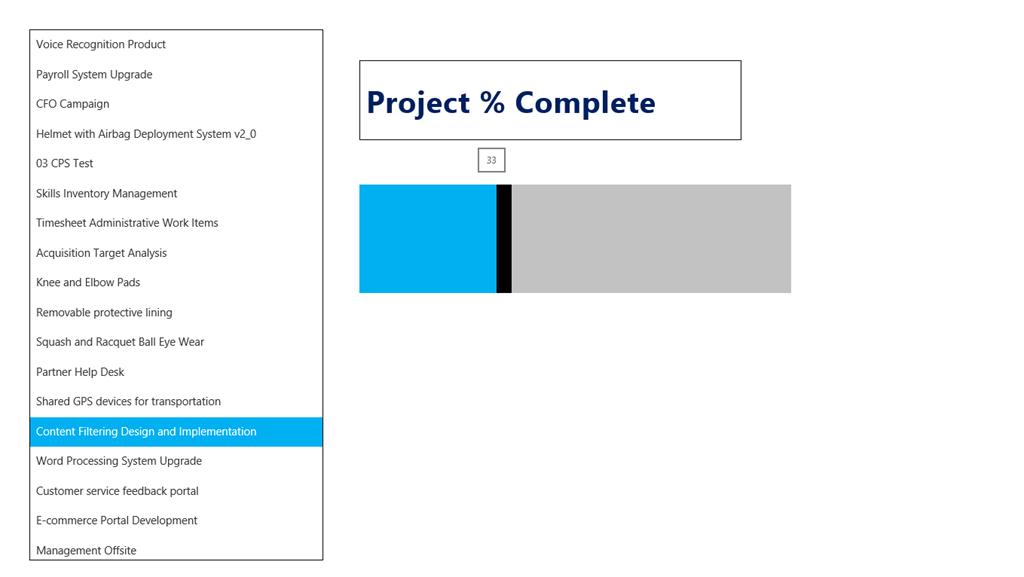
The tooltip shows the % complete.
As mentioned, this is a simple app just to introduce you to Project Siena and demonstrate how easily anyone can create an App with no coding!
Have fun 


#ProjectServer and #SharePoint 2010 / 2013 December 2013 Cumulative Update #PS2010 #SP2010 #PS2013 #SP2013 #MSProject
|
I am a Project Server and SharePoint consultant but my main focus currently is around Project Server.
I have been working with Project Server for nearly five years since 2007 for a Microsoft Gold Certified Partner in the UK, I have also been awared with the Microsoft Community Contributor Award 2011. I am also a certified Prince2 Practitioner. This article has been cross posted from pwmather.wordpress.com (original article) |
The Office 2013 December 2013 Cumulative Updates are now available, please see the links below:
http://support.microsoft.com/kb/2912738
***There is no Project Server 2013 Server Roll up package for December 2013 CU***
Project Server 2013 December 2013 CU:
http://support.microsoft.com/kb/2837668
Project 2013 December 2013 CU:
http://support.microsoft.com/kb/2837665
Also worth noting, if you haven’t done so already, install the March 2013 Public update: http://support.microsoft.com/kb/2768001 if installing the December 2013 CU.
The Office 2010 December 2013 Cumulative Updates are now available, please see the links below:
http://support.microsoft.com/kb/2911591
Project Server 2010 Server Roll up package December 2013 CU (Recommended):
http://support.microsoft.com/kb/2849972
Project Server 2010 December 2013 CU (Included in the Server Roll up package):
http://support.microsoft.com/kb/2849978 & http://support.microsoft.com/kb/2849988
Project 2010 December 2013 CU:
http://support.microsoft.com/kb/2849984
Remember SP1 or SP2 is a pre-requisite for the Office 2010 December 2013 CUs.
As always, test these updates on a replica test environment before deploying to production.
For more details see:


#ProjectOnline deployment experience #Office365 #Project #SharePoint #Cloud #PPM #EPM
|
I am a Project Server and SharePoint consultant but my main focus currently is around Project Server.
I have been working with Project Server for nearly five years since 2007 for a Microsoft Gold Certified Partner in the UK, I have also been awared with the Microsoft Community Contributor Award 2011. I am also a certified Prince2 Practitioner. This article has been cross posted from pwmather.wordpress.com (original article) |
I recently worked solely on a Project Online deployment from start to finish and wanted to share my thoughts and experiences with you. Just to be clear, this isn’t the first Project Online deployment I have worked on, I have been involved in many with CPS but this one I have seen through from the beginning to the end.
Overall the Project Online experience is very smooth and efficient. It was the perfect solution for this particular client I have just finished working for. They weren’t sure exactly what they needed or how long they were going to use the system for as another area of the business was already planning Project Server internally but these guys needed something now. Project Online was the perfect choice, no hardware needed, no internal IT involvement, no capital costs.
When working with Project Online, treat this as the separate product it is. Remember it is not Project Server online, it is Project Online. whilst these two products are similar they are different. Many of the features are very similar but you will also find some features not available in one or the other.
One of the key areas I would say you need ensure you fully understand, certainly if you have been working with Project Server for many years like myself, is the reporting side of things. Whilst the typical end user reporting in Project Online is very simple to use, you are limited by ODATA and don’t have the flexibility of the Reporting database access that we have all got used to. Remember, Project Online is a different product to Project Server 2013 on-premise, so don’t think of Project Online reporting as a limitation compared to Project Server on-premise.
For quick and simple deployments, for me, Project Online is the answer. The key advantages to consider with Project Online that can help form any business case needed are:
- The farm is maintained by Microsoft
- The farm is regularly patched with updates by Microsoft
- The system scalability is all handle by Microsoft
- The system continuity / back up is handled by Microsoft
- Any system issues are raised directly to Microsoft for resolution
- Project Online can be up and running within about 30 minutes
- No hardware required
- No capital costs
These aren’t all the advantages, just the key points i could think of at the time of writing.
Speak to your Gold PPM partner today for a free trial – you won’t be disappointed.


Free #Project 2013 App from CPS #Office365 #Office #Apps #ProjectServer #ProjectOnline
|
I am a Project Server and SharePoint consultant but my main focus currently is around Project Server.
I have been working with Project Server for nearly five years since 2007 for a Microsoft Gold Certified Partner in the UK, I have also been awared with the Microsoft Community Contributor Award 2011. I am also a certified Prince2 Practitioner. This article has been cross posted from pwmather.wordpress.com (original article) |
Just a quick post to highlight a new app that CPS have released for Project 2013, this is the Task Auditor app and can be downloaded using the link below:
http://office.microsoft.com/en-gb/store/task-auditor-WA104172076.aspx
The app can be seen below:

The home page gives a description of the app but also contains a check box to allow the use of Cookies – if you don’t allow the use of Cookies then the configuration settings will not be available and some of the checks might not be 100% accurate.
After checking the check box to allow Cookies, clicking on a task update the app to show the results for the particular task:

At this point also notice there are three tabs, Task, Configure and Help. If you don’t allow Cookies the Configure and Help Tabs will not be visible. The Task Tab displays the checks / tests results for the selected task. The Configure Tab allows the user the enter duration settings and date format:

This is to allow correct calculations for a couple of the checks. These settings are saved and only have to be updated once / as required.
The Help Tab gives details / support for the Configure Tab:

The tests carried out will depend on the type of task selected, Milestone, Summary Task, Work Task etc. The images below show a summary task selected and then a normal work task selected:
Summary Task:

Work Task:

Hovering over the checks, a tooltip gives more information on the check:

Take a look, its free 


Sharepoint 2013 “mark task complete”
A great new feature in 2013 is the ability for a user to “mark task complete” straight from the task list without having to edit the item and click.
Screenshot below illustrates what this is

The issue I had today is that -somehow- the column to tick that task was actually not showing anymore from the task views. The list is definitely a Tasks list but the content type although originally inheriting from the out-of-the-box Task parent Site Collection CT has some custom columns in the site Content Type level.
Cause of issue (why the column was gone): not found yet, may be the “completed” column was edited by a user with design rights, but the formula inside was correct.
Solution: that’s the bad news.
- Re-adding the column again didn’t work as it would not show the column as a Check Box magically but as a value “Yes/No” .. not useful.
- Recreating the view and making it exactly like an out-of-the-box task view did not work, same as above.
- Only solution was to re-create the list fully, and re-add the Custom Task Content Type, then remove the default “Task” Content Type. Once done task can be copy across if needed, as long as there no workflow in progress users will not be disturb as you may even change the URL to the original list later on.
Not a great finding on this feature I am afraid, but since nothing came up on a quick internet search I thought I would share it.
Have you ever wondered how to re-use this “mark as complete” in a fully customised list (not tasks App originally) ? One would think it’s the whole point of having such column, to be able to re-use it somewhere else, right. I could not.
Anyone ?

via François on Sharepoint http://sharepointfrancois.wordpress.com/2013/12/05/sharepoint-2013-mark-task-complete/
 French native Sharepoint Consultant living in London. A crossway between a designer, developer and system architect. Prefers stretching the limit of out-of-the-box features rather than breaking them into code. When not working with Microsoft Sharepoint François is often found on Web2.0 News sites and related social networking tools.
This article has been cross posted from sharepointfrancois.wordpress.com/ (original article) |

#ProjectServer #Project Conference 2014 #ProjectOnline #ProjConf #pm #pmot #projectmanagement #PPM
|
I am a Project Server and SharePoint consultant but my main focus currently is around Project Server.
I have been working with Project Server for nearly five years since 2007 for a Microsoft Gold Certified Partner in the UK, I have also been awared with the Microsoft Community Contributor Award 2011. I am also a certified Prince2 Practitioner. This article has been cross posted from pwmather.wordpress.com (original article) |
The Project Conference 2014 is fast approaching. This is the place to be for information on Microsoft Project, Microsoft Project Server and Project Online. For details see the links below:
http://www.msprojectconference.com/
http://blogs.msdn.com/b/jkalis/archive/2013/11/20/register-for-the-project-conference-2014-now.aspx

See you there!


 SharePoint (and Project Server) Shenanigans
You must be logged in to post a comment.