Archive
Writing History events from a SharePoint designer Workflow
Most SharePoint 2010 solutions will have some form of workflow associated with them.
Workflows written in SharePoint designer can be powerful, but tricky to troubleshoot if they do not work correctly.
Some workflows will complete but not perform as expected, and some will simply fail with the ever helpful An error has occurred in <Workflow Name> written to the history list.
To help us out with this is the Log to History List core action in our workflow designer Action List.

This allows us to write a message to the workflow history, and as such we could write back the value of a workflow parameter or variable that we can check on.
To illustrate this I have written a one step workflow with one Variable and one Parameter, the workflow has an Initiation Form that allows a user to select a colour.

We set the variable varColour to be the value of the colour the user selected which is stored in the parameter ParamColour , on the second line we use the Log to History List to output the value of varColour to the workflow history.

This is what it looks like, firstly we choose a colour from the Initiation Form

The workflow processes and completes, when we check the History list we can see that our message and the value of varColour have been recorded in the Workflow History list

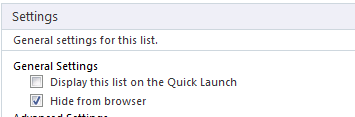
Normally the Workflow History list is hidden from the browser, but you can change this setting in SharePoint Designer.

Excel Services Problem. “An unexpected error has occurred”
I was recently asked to look at an Excel Services problem, where rather then a spreadsheet opening in the browser we were getting the ever helpful “An unexpected error has occurred” screen.
Checking in CA the Excel Services service application seemed to be provisioned, the settings seemed okay and the service was running, a quick check in Windows event log soon found the problem
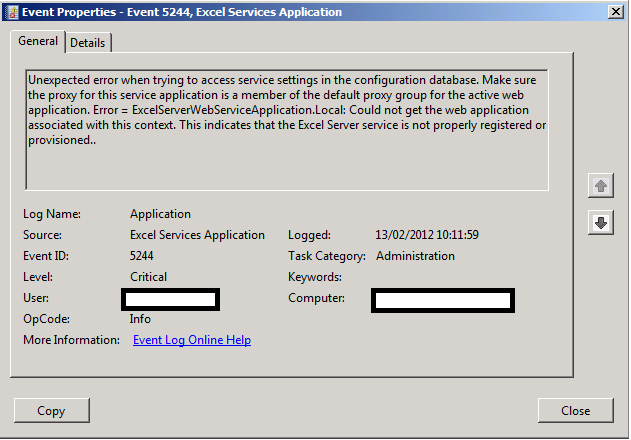
The service application was not registered with the default web application.

As soon as we set the association, Excel Services sprang into life

I passed the #MSProject and #ProjectServer exams #in #MSPC12 #SharePoint #PS2010 #SP2010
Just a quick blog post to say that I took the Microsoft Project and Project Server 2010 exams last week and I am pleased to say that I passed.
Details:
70-177 – Microsoft Project Server 2010, Configuring
- Certification Type: Microsoft Certified Technical Specialist
- URL: http://www.microsoft.com/learning/en/us/exam.aspx?id=70-177
70-178 – Microsoft Project 2010, Managing Projects
- Certification Type: Microsoft Certified Technical Specialist
- URL: http://www.microsoft.com/learning/en/us/exam.aspx?id=70-178
For those who are interested in taking the exams and learning more about Microsoft Project / Project Server can I recommend that you don’t miss out on the event of the year:

Not only will various speaker sessions be available (including myself and my client!) but you will have an opportunity to try for these exams yourself for free!:
Mark the location & date in your calendar: Phoenix, Arizona (March 19th – 22nd 2012) and if you decide to come, let me know and we’ll meet up.

Missing Server Side Dependencies–Useful links for diagnosis and removal #SP2010 #PS2010 #SharePoint #ProjectServer #in
Some quick links to help diagnose the “Missing server side dependencies” errors from the health check analyzer in SharePoint 2010.
Helps remove features via a GUI interface (be careful with this tool!)
- MissingFeature Codeplex Solution: http://featureadmin.codeplex.com/
Removes feature dependencies from the database via PowerShell (be care with this script!)
- MissingFeature Removal PowerShell: http://get-spscripts.com/2011/06/removing-features-from-content-database.html
Once you have removed the dependencies, re-run the health check analyzer for the “Missing server side dependencies” rule and you may have some residual files to clean up in the content database.
Use the following PowerShell scripts to analyse the location of the files and then you can clear them up appropriately:
- Missing WebPart Diagnose: http://get-spscripts.com/2011/08/diagnose-missingwebpart-and.html
- Missing Assembly Diagnose: http://get-spscripts.com/2011/08/diagnose-missingwebpart-and.html
- MissingSetupFile Diagnose: http://get-spscripts.com/2011/06/diagnosing-missingsetupfile-issues-from.html

I’m speaking at Project Conference 2012 – Integrating #SP2010 and #PS2010 #PC12 #SharePoint #ProjectServer #in
Apologies for the lack of updates on the blog, the Christmas / New Year holidays have been really busy. Anyway, just a quick blog post to announce that I will be presenting at this years Microsoft Project Conference in Phoenix, Arizona in March this year.
 |
|
| My Company: Corporate Project Solutions |

If you are attending the conference and you would like to meet up, just let me know. You can contact me here.
Further Details:
Session Title: Integrating SharePoint and Project Server 2010 – Deployment Approaches, Integration Options and making the most of the SharePoint Enterprise Features.
Track: Deployment, Administration & Developer
Level: 300
Audience: IT Professionals, Developers & Consultants
Products: Project Server 2010 & SharePoint 2010
Now that Project Server 2010 is built on top of SharePoint 2010 Enterprise, a new series of options are available with various choices around implementation.
Although integration was possible between Microsoft Office SharePoint Server 2007 Enterprise and Project Server 2007, this was not seen as a standard implementation for many companies and those implementing this approach were defining the rules.
Corporate Project Solutions is one such company who have been taking advantage of these SharePoint Enterprise Features for companies such as ID Business Solutions and ARM to deliver tight integration along with Business Intelligence (self-service dashboards), Document Management and Collaboration.
Solutions created with this approach provide a level of visibility and collaboration previously unseen by these clients and genuinely provide business value for all stakeholders and management / reporting lines.
As a Senior SharePoint Architect who has moved into the Project Server arena in the last 3 years, I initially made many assumptions in the way Project Server works based on the fact it was built on top of SharePoint. This presentation discusses the deployment approaches / configurations of programme and project sites. It outlines 4 options, how they support business intelligence and the pros / cons of each implementation in relation to the project management maturity of the client.
However, during trialling of various implementation approaches, CPS has found a number of pitfalls that do not conform to what is encountered in a SharePoint-only implementation. This demonstration discusses some key difficulties and how to provide a solution that is in accordance with Microsoft best practice and supportable.
Section One – Implementation approach definitions:
Option 1 – Out of the box Project Web Access and Project Sites
Option 2 – Project Web Access as installed with Project Sites customised outside of the standard Project Server 2010 configuration
- Allow custom styles to be applied
- Full use of Search capabilities
- Site Content Types can be utilised to centrally control key lists such as Risks, Issues, Actions and Deliverables
- Workflows can be attached and rolled out by Content Type
- Lists can be updated whilst projects are in-flight centrally as project management maturity evolves.
Option 3 – Project Web Access as installed with centralised lists for all projects / programmes
- Allows all dashboards to be kept in sync as project maturity evolves
- Project and programme roll up dashboards can be implemented using standard out of the box list views and filter web parts (Enterprise Feature)
- Business intelligence reporting becomes easier due to all lists being in sync for all projects / programmes o Reporting is always comparing apples with apples.
However, depending on the approach taken various pitfalls need to be taken into account such as loss of client / server integration features between the Project client and Project Server, cross project security etc.…
A demonstration of each option will show the power and pitfalls of each approach as they are discussed during the presentation.
Section Two: Maintaining consistency and integrity between SharePoint and Project Server
The focus here will move to customisation options using Enterprise Features, taking account of Microsoft best practice.
Examples include:
PSI Web Service integration
- Resource Synchronisation between ERP and Project Server solutions
Project Server Event Handlers
- Linking tasks to SharePoint data and keeping them in sync via Project Server Event Handler
Business Intelligence
- Reporting Services in SharePoint Integration mode and SharePoint Enterprise filters for parameters.
- Complementing the standard BI options of Excel Services & PerformancePoint provided as part of the out of the box Business Intelligence Center site template.
Look and Feel customisation
- Customising the look and feel and adding jQuery to Project Web Access whilst maintaining best practice and supportability. (I.E. Without modifying the Master Page, Page Layouts or using SharePoint Designer)
Section Three: Breaking the rules – discussing key differences between Project Server and SharePoint and how they can be overcome.
For the final section of the presentation, we shall discuss how Project Server doesn’t conform to the techniques that SharePoint consultants use during implementations:
- User Profile Service versus the Resource Pool
- Permission Model
- Project Server vs. SharePoint – Browser compatibility comparisons
- List content types vs. Site Content Types
- Attaching workflows to Risks and Issues
Conclusions
In finish off we shall tie the three separate sections together to discuss end-to-end implementations utilising the most appropriate features of SharePoint and Project Server allowing clients to achieve the best possible solution with the options available.

#SPSUK 2011 Slides and Blog Links #SharePoint #SP2010 #PS2010 #MSProject #ProjectServer #in

Apart from the usual networking you can do at a SharePoint conference, it is also all about the learning of new products, techniques and experiences from fellow like minded individuals.
I personally found the presentations I went too invaluable in confirming decisions I had taken in my own projects as well as learning new subject matters.
So with this in mind I have set about trying to collate the various slides from the events so that I can refer back to them in the future and I thought I would share my results.
Not all slide decks are up yet, but I will endeavour to update this list as they get released.
Enjoy!
Slides from the event:
09:15 to 10:15
| Presenter | Title | Twitter Tag | Slides | Blog |
| Becky Isserman | HTML 5 vs. Silverlight 5 | #spsuk01 |  |
|
| Martin Hatch | Configuring Kerberos in a SharePoint 2010 Farm | #spsuk06 |  |
 |
| Kanwal Khipple | Practical Tips to Increase SharePoint Adoption | #spsuk11 |  |
 |
| Wes Hackett | Putting you at the centre of the Social Intranet | #spsuk16 |  |
 |
| Mark Macrae | Case Study: Delivering SharePoint 2010 BI Dashboards for the Queensland Government | #spsuk21 |  |
 |
| Symon Garfield | How We Did It: Collaboration at a European Central Bank (& what happened next…) | #spsuk26 |  |
 |
| Anders Rask | Developing with Custom Web Templates | #spsuk30 |  |
 |
10:20 to 11:20
| Presenter | Title | Twitter Tag | Slides | Blog |
| Eric Shupps | Customizing the SharePoint Packaging and Deployment Process in Visual Studio 2010 | #spsuk02 |  |
 |
| Paul Grimley | Deploying SharePoint 2010 Globally – The options | #spsuk07 |  |
 |
| Penny Coventry | Automating Business Process with SharePoint Online | #spsuk12 |  |
|
| Ant Clay | Measuring the Intangible, SharePoint Social ROI | #spsuk17 |  |
 |
| Alex Pearce | I’m new to SharePoint for Power Users | #spsuk22 |  |
 |
| Chirag Patel | SharePoint Application Showcase | #spsuk27 |  |
|
| Brett Lonsdale | Comparing Content Aggregation Methods | #spsuk31 |  |
 |
11:45 to 12:45
| Presenter | Title | Twitter Tag | Slides | Blog |
| Chris O’Brien | Custom Ribbon Development | #spsuk03 |  |
 |
| Ben Athawes | Dodge the Bullet – 10 common SharePoint administration mistakes | #spsuk08 |  |
 |
| Matt Hughes | How we did it – Combined Knowledge SharePoint Design | #spsuk13 |  |
|
| Phill Duffy | Introducing Business Connectivity Services | #spsuk18 |  |
|
| Chris Forbes | Extending SharePoint 2010 LOB Apps to Windows Phone 7 | #spsuk23 |  |
|
| Daniel Haywood | SEO for SharePoint 2010 Internet Sites | #spsuk28 |  |
 |
| Marc Anderson | Developing in SharePoint’s Middle Tier  (Demo Site Download) (Demo Site Download) |
#spsuk32 |  |
 |
| Ant Clay and Andrew Woodward | SharePoint Innovation Games workshop | #spsuk39 |  |
 |
13:45 to 14:45
| Presenter | Title | Twitter Tag | Slides | Blog |
| Ben Robb | Client Object Model | #spsuk04 |  |
 |
| Brian Culver | FAST Search | #spsuk09 |  |
|
| Hrayr Diloyan | Advanced Business Connectivity Services | #spsuk14 |  |
|
| Christian Buckley | The connection between metadata / social tools and social productivity | #spsuk19 |  |
 |
| Nigel Price | Why are we developing… | #spsuk24 |  |
|
| Denise Wilson | How SharePoint is being used to manage content at the world’s largest airline | #spsuk29 |  |
|
| Mark Miller | Something Awesome | #spsuk34 |  |
15:00 to 1600
| Presenter | Title | Twitter Tag | Slides | Blog |
| Arri Bakker | Developing for SharePoint Online | #spsuk05 |  |
|
| Todd Klindt | PowerShell | #spsuk10 |  |
 |
| Ian Woodgate | Sort your processes with easy, effective InfoPath Forms and SharePoint Workflows | #spsuk15 |  |
|
| Matt Groves | The most important social feature of SP isn’t in SP – making SP social with Lync | #spsuk20 |  |
|
| Gus Fraser | SharePoint 2010 Intranet Branding for Developers | #spsuk25 |  |
 |
| Dave Coleman & Mike Herrity | Scaling your Architecture from 150 – 150,000 | #spsuk30 |  |
|
| Alan Richards | Using SharePoint 2010 to cut costs | #spsuk35 |  |
 |
16:00 to 16:45
| Presenter | Title | Slides | Blog |
| Steve Fox | SharePoint and the Cloud: Crash or Convergence? |  |
 |

Created by the #SharePoint community – The SharePoint 2010 Handbook #SP2010 #ProjectServer #MSProject #SPSUK #SUGUK #in
** UPDATE ** Thank you for the overwhelming feedback, A Kindle version of the book is in the works and we will keep you posted.
Back in June 2011 Paul Beck asked the community for authors to contribute to a community book on SharePoint 2010 (original post). Various authors have stepped up to the plate and the book has now been released. So without further ado…
A Collection of Short Chapters for Delivering Successful SharePoint Projects
 The SharePoint 2010 Handbook aims to explain some of the key topics of SharePoint 2010 as well as to broaden the understanding of SharePoint so that its full business effectiveness might be better exploited. Each topic has been written as a separate chapter by different authors, each drawing on their own real world experience.
Publication Date: 7th November 2011
ISBN/EAN13: 1466486740 / 9781466486744
Page Count: 448
Binding Type: US Trade Paper
Trim Size: 5″ x 8″
Language: English
Colour: Black and White
Related Categories: Computers / Documentation & Technical Writing

Authors & Chapter Titles:
- 01. Structuring a SharePoint 2010 Practice (John Timney)
- 02. SharePoint Test Environments (Justin Meadows)
- 03. SharePoint Adoption (Veronique Palmer)
- 04. Social SharePoint (Jasper Oosterveld)
- 05. The Art of SharePoint Success (Symon Garfield)
- 06. Exploring Different Options for Implementing SharePoint Solutions (Rene Modery)
- 07. SharePoint Server-based Data Storage and Data Access (Paul Beck)
- 08. SharePoint 2010 Automated Code Deployment (Suzanne George)
- 09. SharePoint Security and Authentication Notes (Conrad Grobler)
- 10. InfoPath 2010 – What is new? (Ashraf Islam)
- 11. Governance in SharePoint (John Stover)
- 12. Creating Dashboards using Business Connectivity Services, SharePoint Designer and other related technologies (Giles Hamson)
- 13. Building Business Intelligence Solutions with SharePoint 2010 (Mark Macrae)
Chapter Descriptions:
01. Structuring a SharePoint 2010 Practice (John Timney)
SharePoint 2010 is simply put, nothing like SharePoint 2007! It is vastly more scalable, significantly more complex, and hugely appealing as an information management hub. A consequence of the successful re-architecture of the product to such a strategic hub product and the core of the Microsoft tools strategy is that programmes and projects, and consequently employers and recruiters need to think carefully about the new range of planning roles and skill sets required to satisfy a successful end to end delivery of SharePoint 2010. This chapter will show the reader how (and equally as important why) to correctly structure a SharePoint Practice or programme of delivery to plan for internal career progression and assist with staff retention and to identify and exploit the correct roles to staff modern demanding SharePoint 2010 delivery programmes.
02. SharePoint Test Environments (Justin Meadows)
Test environments for most IT professionals are a no-brainer — major system changes should be tested once, twice, even three times to provide the best possible experience to end users with little to no interruption in service. Recent virtualization technologies have made this easier than ever; one only needs to spin-up a new instance of a virtual machine and off they go with an entire SharePoint environment at their disposal.
SharePoint administrators will painfully learn, however, that this testing model doesn’t adapt well to the componentized structure underlying a well-built SharePoint system. This chapter will make the case for building and maintaining a fully-scaled test environment that is architecturally similar to an organization’s production environment.
It will support this recommendation with lessons learned from the authors personal experience administering a small SharePoint farm. This case can be argued further to include more than one test environment. If an organization chooses to develop solutions for SharePoint they should consider building in one environment, certifying the build in another test environment, and then implementing the solution in the production environment.
Using one or more fully-scaled test environments is the only way to understand the implications of a major system change. They also provide a mechanism for rehearsing these system changes. With such a tool at their disposal, SharePoint administrators can maintain and administer their systems with confidence.
03. SharePoint Adoption (Veronique Palmer)
There is a common misconception that merely installing SharePoint makes for a successful implementation. It is how the people in the company effectively adopt the solution that is the true measure of success. Have you asked yourself how you will get people to use the solution?
Anyone can cope when there is only one table booked in a restaurant; but what happens when you are booked to capacity with a waiting list – are you geared to cope with that demand? What if you get no bookings at all? Could you explain to your investors why no-one is visiting?
SharePoint user adoption is about how to get to a full house, how to be prepared for the rush, and how to manage it once it happens. People will not magically adopt SharePoint, there are measures you need to put into place to ensure that happens. If this is done correctly, you will have a very high adoption rate and consequently good return on investment for the capital outlay of the infrastructure.
This chapter will cover what you need to do in order to achieve that.
04. Social SharePoint (Jasper Oosterveld)
The word ‘Social’ has become a very popular term over the last couple of years. Everyone is familiar with Facebook, Twitter and YouTube. These so-called Social sites attract (hundreds) millions of visitors per day! So how does this translate to SharePoint 2010? What Social features are available? Social features were also available (albeit limitedly) in the previous version Microsoft Office SharePoint Server 2007 (MOSS 2007).
The main feature was the My Site. This site is a personal page for every user within a SharePoint Intranet portal. The user was able to provide valuable information for colleagues, such as a mobile number, e-mail address, manager or skills. Other users were able to use the MOSS 2007 search engine to find a colleague with the skill ‘Writing marketing material’, for example. By using these features, users were able to connect and share information with each other.
This has been improved in SharePoint 2010 and loads of new features are now available. This chapter describes these features, and how they can improve the collaboration within your organisation. Talking points covered include My Sites, Tags and Notes, Ratings and Social Search. Most importantly, the author addresses how they are all connected and what advantages they provide for companies.
05. The Art of SharePoint Success (Symon Garfield)
Microsoft SharePoint products and technologies have been in the market for ten years the fourth version, SharePoint 2010, was released in November 2009. There is no doubt that SharePoint is a phenomenal success: It is Microsoft’s fastest selling server based product ever and has generated approaching two billion dollars in sales revenue for Microsoft. The only other Microsoft Server products to generate this level of revenue are SQL Server and Exchange Server, and SharePoint has reached this milestone more quickly than the others.
There have been over one hundred million SharePoint licenses have been sold worldwide and I.T. industry analysts such as Forrester Research and Gartner rank SharePoint as a leader in a number of different technology markets including Search, Enterprise Content Management, Social Computing, Collaboration, Information Access and Horizontal Portals.
SharePoint will be at the heart of Microsoft’s information worker strategy for many years to come. Yet despite its market success many organisations seem to struggle to realise the full value from investments in SharePoint products and technologies. In 2010 AIIM survey found that forty seven percent of organisations that have deployed SharePoint use it primarily as a file share. In May 2011 research commissioned by Fujitsu shows that SharePoint is the most common collaboration tool used by UK businesses, Ninety two percent of Enterprise organisations using collaboration technology use SharePoint. But the research also shows that on average only sixty percent of SharePoint sites are considered active, and forty percent of IT managers don’t believe that the collaboration platform is driving cost savings.
This chapter first explores the challenges facing organisations investing in SharePoint based initiatives, and then presents a framework for success consisting of four elements; Governance, Strategy, Transition, and Architecture. Governance relates to defining the accountability for the ensuring a return on the investment in SharePoint. Strategy discusses how SharePoint relates to organisational objectives. Transition considers the challenges of organisational change and user adoption and Architecture relates to the way that SharePoint is deployed to the business as a set of distinct but inter-related services.
06. Exploring Different Options for Implementing SharePoint Solutions (Rene Modery)
An important decision to make while planning the implementation of any SharePoint solution is how exactly it should be created. Two commonly used options are leveraging the out of the box available functionality through customization in the browser and development of solutions using custom code.
SharePoint’s out of the box functionality empowers end users to create simple solutions with little effort and in a short time frame, however with a limited customization scope. Development of custom code solutions provides the most flexibility, however at a higher cost in terms of complexity and resource requirements. Another option is to extend the standard SharePoint functionality with customizations that make use of JavaScript and the Data View Web Part.
Using JavaScript has become a very popular way of extending SharePoint without having to rely on custom code. It allows users with some basic development knowledge to create their own more advanced solutions easily.
Considering all these possibilities, when evaluating the correct course to take for a solution implementation, organizations need to take into account the pros and cons of the different approaches, and weigh them against each other.
This chapter will compare these approaches with each other and describe the capabilities, as well as the benefits and the drawbacks of each approach, allowing a decision maker to better understand which method is useful in which situation and choose the best option.
07. SharePoint Server-based Data Storage and Data Access (Paul Beck)
This chapter guides readers through the basic storage and data access options available in SharePoint 2010 application development projects. The matching of application business requirements with the appropriate storage and data access technique is vital for achieving a successful project.
08. SharePoint 2010 Automated Code Deployment (Suzanne George)
During the past several years SharePoint has quickly become one of the leading collaboration technologies. Businesses today are taking the SharePoint framework from the development labs into mission critical production environments which require application high availability. This chapter will describe methods and concepts which will ensure you will be able to build and deploy custom code into Intranet and/or Internet facing production farm(s) using Visual Studio 2010, Team Foundation Server 2010, and SharePoint 2010. Further, a description of the concepts and tools necessary to ensure code consistency throughout the development lifecycle will be included.
SharePoint Internet facing sites often have additional requirements, network bottlenecks, and limited downtime constraints which make deploying code from the development arena through QA/staging, and finally into production SharePoint farms more restrictive. The new capabilities provided in Visual Studio 2010, Team Foundation Server 2010, and SharePoint 2010 make this process much easier than before.
This chapter will provide examples for all flavours of deployments (timer jobs, page layouts, web parts, etc.) so you don’t have to learn as you go! You’ll get an in-depth look at how these tools can help you successfully deploy code into production SharePoint 2010 farms.
09. SharePoint Security and Authentication Notes (Conrad Grobler)
SharePoint 2010 provides different options for authentication of users as well as authentication to external line-of-business systems. During the design and implementation of a SharePoint 2010 solution, the chosen authentication method could impact or restrict the availability of some SharePoint functionality and the options for interacting with external systems.
This chapter will discuss the different options and architectural considerations for user authentication and for authenticating to external systems. It will cover classic mode authentication and claims based authentication. It will cover NTLM, Kerberos, Clear Text Authentication, Forms Based Authentication and Trusted Claims Providers, the Claims to Windows Token Service and the Secure Store Service Application. It will also give a brief overview of options for exposing
SharePoint 2010 sites securely across the Internet, such as using Microsoft Forefront Threat Management Gateway, and the implications of doing this and how to ensure the security of business data exposed using SharePoint.
The chapter will provide information on configuring and troubleshooting the authentication options such as Kerberos, Clear Text and Forms Based Authentication, the differences between the SharePoint 2010 FBA implementation and ASP.Net forms authentication and the implications for interoperability between SharePoint and ASP.net applications. It will also provide information on the limitations of certain functionality (such as search based alerts and the people picker) for Forms Based Authentication and Trusted Claims providers.
10. InfoPath 2010 – What is new? (Ashraf Islam)
This chapter is dedicated to exploring the capabilities of InfoPath 2010. What can InfoPath can do for you? What are the key improvements to InfoPath 2010 and the impact on form design and development.
InfoPath 2010 has interesting license implications and this deserves some attention. The chapter also discusses key concept and building blocks of InfoPath Forms (such as rules, data connection, design template and data validation) using scenario based solution. The chapter also demonstrates how to write c# code for control and form events.
InfoPath is an agile/rapid design tool for creating forms. InfoPath is intricately linked with SharePoint so it would be ideal if you know the basics of SharePoint 2010. This chapter will give you a solid foundation for people new to SharePoint and will allow more advanced users to see what is new in InfoPath 2010.
The chapter ends by discussing potential issues and what users might be expecting from Microsoft for the next release.
11. Governance in SharePoint (John Stover)
Governance relates to the process and plans used to define expectations, grant power, and verify performance. SharePoint Governance describes the specific plans and procedures for managing your SharePoint environment.
SharePoint’s widespread adoption, broad capabilities, ease of use, and multiple deployment and hosting options have made it easy for anyone to get started using SharePoint. It’s this same flexibility that can also make SharePoint difficult to effectively manage. In order to optimize the use and growth of SharePoint, your SharePoint Governance Plan should be used to define expectations, grant and restrict rights, as well as maintain and verify usage and performance.
Due to vast differences in SharePoint environments, a SharePoint Governance Plan should be adapted to your specific environment, regardless of how simple or complex your environment is. This chapter will serve as a guidebook outlining processes for the administration, maintenance, and support of your SharePoint solution.
There are three primary goals of this chapter: To provide a recommended structure for a SharePoint Governing Board responsible for governing and supporting the SharePoint solution. To provide recommended governing policies and procedures of the SharePoint environment within three distinct areas (IT Governance, Application Governance, and Information Governance) and to provide a recommended user adoption and training strategy for the people using and maintaining SharePoint.
12. Creating Dashboards using Business Connectivity Services, SharePoint Designer and other related technologies (Giles Hamson)
When I look back at my days of learning SharePoint and dashboards etc. in SPS 2003 & MOSS 2007, I had to learn from various articles on the internet about each specific component and then bring them together myself so that I could provide a cohesive end to end solution for my clients.
If I knew then what I know now, projects could have gone a lot smoother.
This chapter covers the end to end cycle of linking to 3rd party Line Of Business (LOB) applications, authentication and creating reports explaining the concepts along the way.
By completing this module the reader will have gone from end to end understanding the following subjects:
- Secure Store Service (previously Single Sign On service – MOSS 2007)
- Business Connectivity Services (previously Business Data Catalog (BDC) – MOSS 2007) connecting to SQL Server views via SharePoint Designer 2010
- Dashboard pages with drill downs using the BDC Web Parts
- Excel Services directly connected to the SQL and refreshable.
This chapter compliments chapter 13 (Building Business Solutions) by providing step by step instructions to achieve your solutions using key Enterprise features.
13. Building Business Intelligence Solutions with SharePoint 2010 (Mark Macrae)
In this chapter we will explore the variety of tools available in SharePoint 2010 to provide business intelligence to your business users. We will examine the pros and cons of each tool along the way, and look at a couple of methods of building a powerful dashboard from the items we construct.
Creating dashboards and drill downs using Business Connectivity Services, SharePoint Designer, Filter Web Parts and Reporting Technologies.
This chapter covers the creation of dashboards and drill downs utilising SharePoint Designer 2010, Business Connectivity Services, Secure Store Service, Business Data Catalog Permissions & Actions. It demonstrates Filtering Web Parts & Connections to List Web Parts and explores Excel Services.
The chapter will be a guide to using SharePoint Designer 2010 to connect to SQL Server data sources with External Content Types. It will discuss the rationale for using the Secure Store Service and the Business Data Catalog.
It does this by utilising a real world Customer Information Portal scenario for a Products & Service Company. The company has a requirement to bring together information from various disparate systems within the network to aid a number of departments.

The #SharePoint Saturday UK 2011 Experience #SPSUK #SP2010 #ProjectServer #MSProject #in
So this weekend was the 2nd SharePoint Saturday to be in the UK and my the 1st SharePoint conference I have ever been to and I have to say I was very impressed.

The setting, Nottingham University. Sitting there at the beginning of the day in one of the lecture theatres, memories of my university days came flooding back. A Robin Hood guide initially setting the scene and Todd Klindt starting with his keynote on stepping out of the comfort zone and gaining extra qualifications to become a more rounded consultant.
In his case, a SharePoint Administrator through and through but has always dabbled in scripting and other development work (not that he would publically admit to, until now). However his journey of studying for the SharePoint 2010 development exams has allowed him to not only become a better administrator with troubleshooting event logs etc. but to also gain further knowledge in PowerShell and the his fellow development colleagues.
Like other known SharePoint bloggers have stated (Joel Oleson, Bill Simser etc.), it is impossible to know everything about SharePoint, the product is just too big. However, learning more and more about SharePoint and the surrounding technologies is part of the fun and is certainly why I continue to love what I do and why SharePoint merges between by professional and personal life.

After the keynote, my colleague (Francois) and I went to see Becky Isserman (@mosslover) and her presentation on HTML 5, Silverlight and how they work in SharePoint 2010. The answer being clear cut where SharePoint is concerned. HTML 5 and SharePoint 2010 doesn’t really mix with the master pages provided out of the box and the current state of cross browser / platform compatibility of HTML 5 really means that as far as business applications within SharePoint are concerned, Silverlight is really your best choice (mobile browsers not withstanding).
The 2nd session I attended was Paul Grimley’s Global Deployment discussion. This not only validated in my mind the choices I have made in previous projects but really hit home that sometimes decisions around SharePoint deployment are just hard and is just as much about the political challenges as well as the technical challenges.
During this session, I met up with an old colleague and fellow blogger on this site, Paul Griffith. We had a good catch up about old times, current projects and challenges and decided to go to the next session together: Chris O’Brien’s Custom Ribbon Development.

This session really showed off the power of the fluent UI ribbon functionality and the level of customisation that could be achieved but left me wondering… With the kind of clients I deal with, how can I justify the cost of developing these customisations. Perhaps I need to spend some time out learning these techniques to ensure value can be perceived with this development work.
 During lunch I met up with my colleagues and we exchanged details about the sessions we attended before moving on to the next sessions. For this I decided to attend the Ask The Experts session. Although I didn’t have any questions myself, it was a good time to digest what I had seen already and also time to catch up with Paul Beck.
Paul Beck, myself and several other bloggers have over the last 6 months been writing chapters for a community book (The SharePoint 2010 Handbook). Having only ever spoken to Paul over email, it was an absolute pleasure to meet the man who has been embarking on this ambitious project. The good news is of course that the book is now finished, published and available on Amazon.com as of yesterday! This was also the first time I got to see the printed book in real life. I know have this copy proudly sitting on my shelf at home. (a full blog post about this will be following this week).

During the Ask The Experts session I also found myself in conversations with various other people I read blogs or listen to podcasts about. The sense of community between the bloggers, presenters etc. is amazing and long may it continue.
My last session before the final keynote was Todd Klindt’s PowerShell session. Many unanswered questions came out of this and I know I shall be using this knowledge again and again (I feel my Linux scripting days coming on again).
The final keynote with Steve Fox from Microsoft Consulting Services discussed how SharePoint Online, Business Intelligence and Azure comes together to truly provide a complete cloud based solution. The session went off without a hitch and showed off the power of what we will all be involved in for future projects.

To end the day, prizes were given out by the sponsoring vendors many of the attendees ended up in the centre of Nottingham for a SharePint and while others went off to ensure the night followed through to morning, I went back to my hotel room and went out to dinner with my partner who had spent all day in the hotel spa.
All in all, a very successful event and a big thank you to those who co-ordinated, supported and presented at the 2nd SharePoint Saturday event in the UK.

#SharePoint Web Front-End HTTP 404 Response but no errors in the log #SP2010 #PS2010 #MSProject #ProjectServer #in
Recently we had to restore a content database from back up at a client. We were working on APP1 of a 2 WFE + Database configuration.
We followed the usual steps:
- Restore database into SQL Server from backup as a different name (<ServerName>_ContentDB_20111028)
- Log into Central Administration
- Go to Manage Content Databases
- Remove the existing Content Database
- Add the newly restored database (<ServerName>_ContentDB_20111028)
- Restart IIS (not required but just for good measure)
After doing this, APP1 worked find, but APP2 however kept giving the HTTP Response Error: 404.
We checked the usual places:
- ULS Logs
- Windows Event Logs
- IIS Logs
No other errors apart from the 404 Not Found error.
To try and force an error we went to some the standard SharePoint pages on the file system such as:
- /_layouts/settings.aspx
- /_layouts/create.aspx
This forced the following error to appear in the ULS logs:
- Unexpected System.NullReferenceException: Object reference not set to an instance of an object
A quick Google and the following came up:
The steps below are slightly modified from the one mentioned in the post but it ultimately resolved the issue:
- Stop the OWSTIMER service on the problem SharePoint WFE server in the farm.
- On the problem server, navigate to:
Server 2003 location: Drive:\Documents and Settings\All Users\Application Data\Microsoft\SharePoint\Config\GUID and delete all the XML files from the directory.
Server 2008 location: Drive:\ProgramData\Microsoft\SharePoint\Config\GUID and delete all the XML files from the directory. - Delete all the XML file in the directory. NOTE: ONLY THE XML FILES, NOT THE .INI FILE.
- Open the cache.ini with Notepad and reset the number to 1. Save and close the file.
- Start the OWSTIMER service on the server and wait for XML files to begin to reappear in the directory.
- IIS Reset (just for good measure)
Took us a good couple of hours to resolve this one, so hopefully it can help you too.
Full Log Example:
10/28/2011 09:30:41.30 w3wp.exe (0x1508) 0x1204 SharePoint Foundation Runtime tkau Unexpected System.NullReferenceException: Object reference not set to an instance of an object. at Microsoft.SharePoint.SPSite.PreinitializeServer(SPRequest request) at Microsoft.SharePoint.SPWeb.InitializeSPRequest() at Microsoft.SharePoint.WebControls.SPControl.EnsureSPWebRequest(SPWeb web) at Microsoft.SharePoint.WebControls.SPControl.SPWebEnsureSPControl(HttpContext context) at Microsoft.SharePoint.ApplicationRuntime.SPRequestModule.GetContextWeb(HttpContext context) at Microsoft.SharePoint.ApplicationRuntime.SPRequestModule.PostResolveRequestCacheHandler(Object oSender, EventArgs ea) at System.Web.HttpApplication.SyncEventExecutionStep.System.Web.HttpApplication.IExecutionStep.Execute() at System.Web.HttpApplication.ExecuteStep(IExecutionStep step, Boolean& complet… 97bd5397-9665-4f46-82ed-c5e702f8ccd0
10/28/2011 09:30:41.30* w3wp.exe (0x1508) 0x1204 SharePoint Foundation Runtime tkau Unexpected …edSynchronously) 97bd5397-9665-4f46-82ed-c5e702f8ccd0
#SharePoint You Tube web part now up on #codeplex #SP2010 #ps2010 #projectserver #MSProject
Although I don’t get to develop as much as I would like, I do occasionally spot a need and create a web part or two.
In this case my marketing department wants to put videos that are on our company You Tube channel on to our website.
Now to the techies of the world you may be thinking. This is easy, Content Editor Web Part, copy and paste the embed code and done. However, if the web site is being maintained by non-technical people, things can get into a muddle pretty quickly.
As a result of this I started to look at the You Tube iFrame Embed API and found all sorts of interesting options. So this web part provides access to most of the features found in the API. The most interesting of which is the playlist option with a comma separated list of Video ID’s.
Take a look at the video below:
Hopefully other people will find it useful also.
Details:
Title: SharePoint You Tube Web Part
Versions Supported: SharePoint Foundation 2010, SharePoint Server 2010, Project Server 2010
Type: Farm Solution (Hoping to make it a sandbox solution, but was having issues…)
URL: http://spyoutube.codeplex.com
Have fun!


 SharePoint (and Project Server) Shenanigans
You must be logged in to post a comment.