Project Professional 2013 Reports
 With the preview version out I was able to play around with Project Professional 2013. Like always this is the preview version so things might change.
When playing around with Project Professional 2013 I came by a new feature that I just had to blog about. Reports in Project Professional were not always of best use. They had their uses but in my experience I hardly used them.
In Project Professional 2013 however Microsoft decided to do something cool.
They basically made a report dashboard. There are a few pre-defined reports to choose from:
- Project Overview
- Work Overview
- Burndown
- Cost Overview
And much more…
One option in particular is very cool. Creating your own report by the use of a pivot table mechanism. This makes it very easy to create a report in a few clicks. Add that with all the different options available to you, you have the ability to create a really useful reports in mere minutes.

This for me personally is a major improvement on Project Professional 2010. It enhances the ability of Project Managers to get good and valuable reports. In this dashboard you can do some cool actions. Like for instance, adding your company logo to your report.

This report capability also gives you the ability to rearrange all the fields. This is very handy for any Project Manager. How many times have you been fiddling with a report to fit everything on one page. This time is has been made really easy.

Next to that you have the option to add charts, table and textboxes and much more…
Next to that you have the option to add charts, table and textboxes and much more…
All in all too much to sum up in a small blog post. I would say experiment with it. In my opinion this greatly increases the usability of Project Professional 2013 for any Project Manager. A really good use for these reports would be a Checkpoint Report or Highlight Report.
I am really impressed by this feature, and what it can do, and what it means for anyone that needs to report on a project. The easy to use prebuilt reports already cover the most of report a Project Manager needs.
I am off to see what else Project Professional 2013 has in store for me. But for now consider me impressed.


via SpeakingSilent » Robin Kruithof http://speakingsilent.wordpress.com/2012/07/30/project-professional-2013-reports/
   I am Robin Kruithof. I am working at CXS in the Netherlands as a Microsoft Project Consultant. My passion lies in Project Management and everything in the Project Management domain.
This article has been cross posted from speakingsilent.wordpress.com/ (original article) |

#ProjectServer #PS2013 Log Level Manager #SP2013 #SharePoint #MSProject #PowerShell
 I am a Project Server and SharePoint consultant but my main focus currently is around Project Server.
I have been working with Project Server for nearly five years since 2007 for a Microsoft Gold Certified Partner in the UK, I have also been awared with the Microsoft Community Contributor Award 2011. I am also a certified Prince2 Practitioner. This article has been cross posted from pwmather.wordpress.com (original article) |
There is new feature in Project Server 2013 called the Log Level Manager that enables you to track certain entities such as Projects, Resources and Tasks etc. Once configured, all activity on the farm for that particular entity, depending on the logging level set, is logged in the SharePoint ULS logs.
More details can be found here:
http://technet.microsoft.com/en-us/library/ff631142(office.15).aspx#section16
The log level manager is configured using PowerShell, the Project Server 2013 preview PowerShell commands can be found here:
http://technet.microsoft.com/en-us/library/ee890097(office.15).aspx
For the purpose of this blog post I have enabled logging for one test project, the project is called PMPSTest1 and the project GUID is 35cafba6-38d6-e111-9923-4c809328175b. Below you can see the PowerShell commands used to set up the logging for this one project:

Notice the refresh command, this is required to update the cached list of entities to watch.
As mentioned above the log level manager writes the logs into the SharePoint ULS logs, an example can be seen below:

An example entry:
LogLevelManager!PWA:http://vm657/PWAClassic, ServiceApp:Project Server Service Application, User:i:0#.w|cps\paulmather, PSI: Start checkout of project ’35cafba6-38d6-e111-9923-4c809328175b’ by resource ‘f8a06617-38d6-e111-bf72-00155d1463b9′ to store ‘WorkingStore’. Project:35cafba6-38d6-e111-9923-4c809328175b Original TraceLevel:Medium 9f6fbd9b-85f6-e003-5b7a-17f60ec5f059
The SharePoint ULS logs aren’t the nicest of log files to look through at the best of times, never mind trying to look for logs regarding the specific Project Server entities that you are tracking. I will create a simple PowerShell script to take all of the log level manager entries from the ULS logs and place these into a new text file/s. This will enable you to view all of the Project Server log level manager entries without the other SharePoint entries.
The log level manager is very useful for auditing / tracking activity for a certain project, task or timesheet etc. It would not be recommended to enable verbose logging for all entities in Project Server though!


SharePoint 2010 #Web.Config Errors
Working with a client recently, they wanted to have a look at some of the BI options offered by SharePoint, so we created a site from the BI template and looked at Excel Services and the Performance Point sample pages, Excel Services worked fine but Performance Point gave the error below that is mentioned elsewhere on this fine blog 
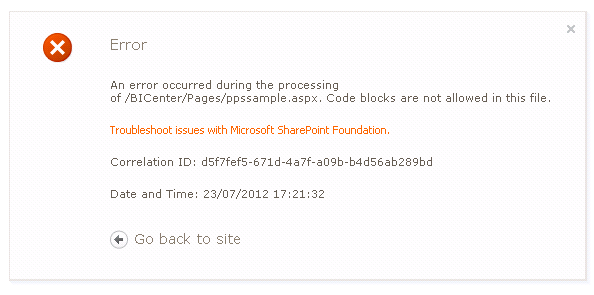
So a quick change to the web.config files was in order for the 2 web servers in the farm.
I went to the 1st server, backed up the web.config file, the made the change and all was good.
Went to the 2nd server, backed up the web.config file, the made the change and BANG internal error
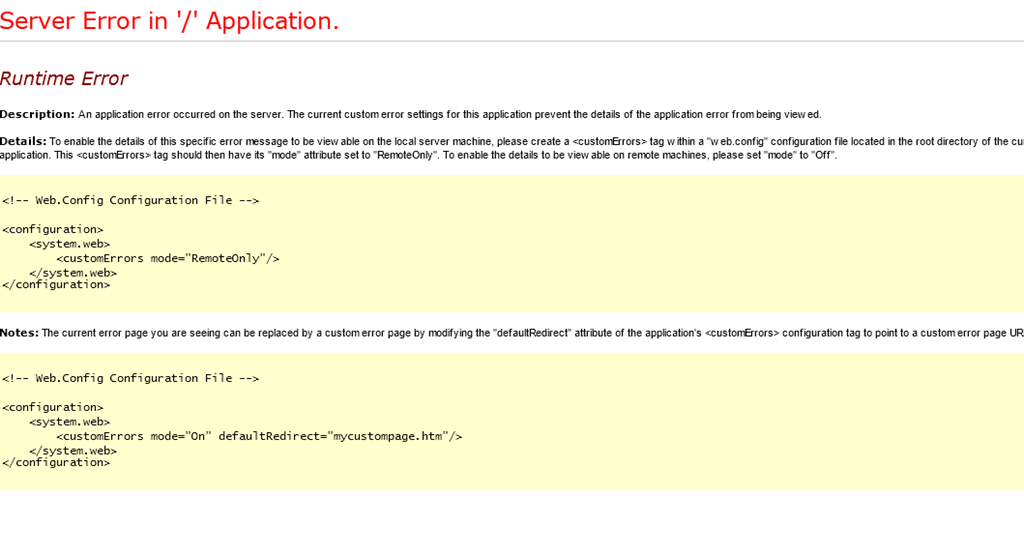
I backed out the change, same error, put back the previous web.config, same error..hmm not good…. did a few IIS Resets, same error…hmm not good at all..
Finally looked at the servers event log and spotted the following text in the event

It is an error to use a section registered as allowDefinition=’MachineToApplication’ beyond application level. This error can be caused by a virtual directory not being configured as an application in IIS. (C:\inetpub\wwwroot\wss\VirtualDirectories\<Portal Site\app_globalresources\web.config line 355)
The path looked a bit odd so I checked in the app_globalresources folder and I had indeed somehow managed to copy a version the web.config file in to it. Deleted the file and SharePoint sprang back into life.. so the moral of the story is always read the error..
Happy SharePointing.

#SharePoint #SP2013 Project Site visibility in #ProjectServer 2013 #Office365 #PS2013
|
I am a Project Server and SharePoint consultant but my main focus currently is around Project Server.
I have been working with Project Server for nearly five years since 2007 for a Microsoft Gold Certified Partner in the UK, I have also been awared with the Microsoft Community Contributor Award 2011. I am also a certified Prince2 Practitioner. This article has been cross posted from pwmather.wordpress.com (original article) |
In this post I will look at the new functionality that allows you to have visibility of the SharePoint 2013 project sites / SharePoint sites that have a Task list in Project Server 2013. I mentioned this functionality in a previous post last week: http://pwmather.wordpress.com/2012/07/19/first-look-at-projectserver-online-office365-ps2013-sp2013/
The SharePoint 2013 Project Site template by default has a Task list so these will be available to add to Project Server, if you add the Task list to other SharePoint 2013 sites in the PWA site collection these will also be available to add to Project Server 2013.
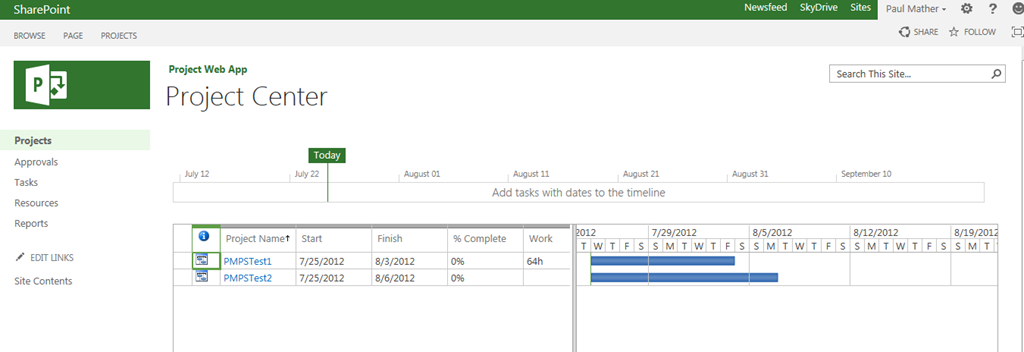
For the purpose of this post I have a couple of test projects that are managed by Project Server, these are called PMPSTest1 and PMPSTest2. I also have 2 SharePoint Project Sites that contain tasks ready to be added to Project Server, these are called PMSharePointTest1 and PMSharePointTest2.
Firstly lets take a look at the project centre, here we can see the two Project Server projects as mentioned above.
Below are the two SharePoint 2013 sites created from the Project Site template:
Project Site template:

Project Sites:

Notice one task is assigned to Lee Mather – he is not currently a resource in Project Server.

Lets take a look at the Project Server Project Sites, we will use PMPSTest1 for this. As you can see below the tasks from the project plan do not appear in the Tasks list on the associated project site as this project is managed via PWA:


Notice the message stating that this project is managed by Project Server Project Web App.
Before we add any SharePoint sites to Project Server I just want to show the projects in the reporting tables from the ProjectServer database:

Now we will look at adding a SharePoint site, see the steps below:
Navigate to the Project Centre, click the Projects tab > Add SharePoint Sites:


Notice the three SharePoint sites, two are created from the project site template the there site is a team site with the Task list added.
Select PMSharePointTest1 and click Add:

Click Close
Below is a screen shot of the Project Server queue showing all of the successful jobs for adding this SharePoint site task list to Project Server:

Once the jobs have completed successfully, refresh the Project Centre and you will see the SharePoint site:

Clicking the PMSharePointTest1 project takes you to the Task list on the site:

Notice the quick launch on the site now has a Project Details link, this gives you access to the Project Detail pages for this project:

As this is not an enterprise Project Server project you cannot edit the tasks from the PDP.
Looking at the resource centre, you can see that Lee Mather has been automatically added as a resource to Project Server as he was assigned the task SPTask3 on the SharePoint task list:

Looking at the Resource assignments for my account, you will see that all tasks (from both enterprise projects and the SharePoint task list) are displayed:

The SharePoint task list project (PMSharePointTest1) will also be available in Project Professional 2013:

Project Professional synchronises with the SharePoint task list, new tasks can be added using Project Professional and these are synched back to the SharePoint task list on the PMSharePointTest1 site:

Saving the project will sync the tasks back to the Task list:


Running the same SQL query against the Reporting tables / views in the ProjectServer database now includes the tasks from the SharePoint site that was added. This enables reports to be easily created using Excel / SSRS etc.:

Notice the ProjectVisibilityMode column, for the SharePoint project site the value is 1, for enterprise projects the value is 0.
The data is also available in the Project Server OLAP cube, example below looking at the MSP Portfolio Analyser cube:

The SharePoint task list can be removed from Project Server using the normal delete enterprise object functionality – if you want to keep the SharePoint site do not check the box “Delete the connected SharePoint sites”!
The SharePoint task list can be converted to fully managed enterprise project using the active button on the Connected SharePoint Sites page:

After clicking Activate, the project will appear and function as a normal enterprise Project Server project and set the SharePoint task list to read only. Deactivating will set the project back to a SharePoint task list managed project.
Projects created in Project Server can also be deactivated and managed via the Task list.
This new functionality is great for organisations that want the visibility of lightweight projects in Project Server. This enables both types of projects, enterprise projects and task lists, to be visible in one central location and also make use of the full reporting capability of Project Server.
For more details see the links below:
http://technet.microsoft.com/en-us/library/ff631142(office.15).aspx#section5
http://technet.microsoft.com/en-us/library/ff631142(office.15).aspx#section10


SharePoint 2010 and 2013 WSP
Nice post here about creating a WSP for both 2010 and 2013. Or i should say upgrading your 2010 WSP to work on both
http://www.danlarson.com/sharepoint-2010-and-2013-wsp-compatibility/

via Buzz Blog http://paulbuzzblog.wordpress.com/2012/07/25/sharepoint-2010-and-2013-wsp/
 Paul is a an expert SharePoint and Project Server developer and is responsible for designing and implementing custom solutions on client systems using the latest SharePoint and .NET technologies.
Paul has extensive experience with SharePoint systems across all sizes of implementation, ranging from small to large farms and has an excellent understanding of all the elements of SharePoint. This article has been cross posted from speakingsilent.wordpress.com/ (original article) |

SPandPS.com huh? what’s that all about?
Over the past year, I have been adding various site authors to the blog originally known as Giles’ SharePoint (and Project Server) Shenanigans. However, as more and more people have come on board, the blog has become less about my posts and more of a group effort.
Introducing SPandPS.com…

To reflect the group effort of Site Authors and Cross Posters, I have rebranded the blog as SPandPS.com and the transformation is almost complete with the following new features:
 Email (Contact Form)
- Facebook Page
- RSS
- Twitter Account
- YouTube Channel
- CodePlex Projects

I will still be posting at my normal frequency and to the same quality you have come to expect and the site authors / cross posters contributing articles as and when they come up with content.
I hope you all enjoy the new content and if you have any suggestions or would like to guest blog or become a site author… get in contact.
PS. You can still access the blog using the original URL and feed (https://ghamson.wordpress.com & https://ghamson.wordpress.com/feed)

Project Online a new step forward
Just as always Project Online and Project Professional 2013 are out in the preview version. A lot of changes can still be made. I also want to point out that statements I make are mostly based on assumptions. As I don’t know what the final product will actually bring.
With the preview version coming out Microsoft also showed Project Online. So what is it? It is basically the office 365 version of Project Server. Project Server at the moment is only available as a Server product. For small – medium companies this might be too expensive to support.
With the coming of Project Online small-mid sized companies have the ability to benefit from almost all the capabilities of Project Server (Depending on the prize of course). Because it is based on office365 it a lot easier for small to mid sized companies to get there hands on it.

Project Online Home Page
This will open doors for these companies to start thinking about Enterprise Project Management (EPM). Meaning enterprise resource management, portfolio management en centralized project store for all the projects within the company.
Why would I still buy Project Server if Project Online is available? For me as it looks now in the preview version, Project Online can be categorized as a Project Server starter kit. It has a fare share of the functionalities and features of Project Server but has in its office365 environment somewhat limited configuration and development capabilities. Meaning branding, custom solutions, custom reports and probably more.
For bigger companies this might be a reason to go for a Project Server deployment instead of Project Online.
However I do think Project Online will be a great way for small to mid sized companies to experience Project. It is a great way for these companies to start managing Projects, Resources and Portfolios in a entirely different way.
If you want to test out Project Online you can do that here: http://www.microsoft.com/project/en-us/preview/default.aspx
I think Microsoft made a great leap forward with Project. I can’t wait to help new clients to set this up. Because don’t be fooled even Project Online needs a little bit of configuration before you can start using it for your company. Always remember the tool is easy, the process in your company around EPM is not.

via SpeakingSilent » Robin Kruithof http://speakingsilent.wordpress.com/2012/07/24/project-online-a-new-step-forward/
|
I am Robin Kruithof. I am working at CXS in the Netherlands as a Microsoft Project Consultant. My passion lies in Project Management and everything in the Project Management domain.
This article has been cross posted from speakingsilent.wordpress.com/ (original article) |

Best source code plugin for wordpress and Live Writer
See here for the best source code plugin
http://richhewlett.com/wlwsourcecodeplugin/

via Buzz Blog http://paulbuzzblog.wordpress.com/2012/07/23/best-source-code-plugin-for-wordpress-and-live-writer/
|
Paul is a an expert SharePoint and Project Server developer and is responsible for designing and implementing custom solutions on client systems using the latest SharePoint and .NET technologies.
Paul has extensive experience with SharePoint systems across all sizes of implementation, ranging from small to large farms and has an excellent understanding of all the elements of SharePoint. This article has been cross posted from speakingsilent.wordpress.com/ (original article) |
Practice makes Perfect Pt 1 – Timeline #MSProject #ProjectServer #Office365
I am often asked “why should we upgrade from Project Professional 2007 to Project Professional 2010”. My answer would be “Why not” Project Professional 2010 has some new features/functions that can make a Project Managers live a lot easier.
In the first part of Practice makes Perfect I am going to talk about one of these new features; the Timeline.
“With the new office version Project Professional 2013 coming out in preview I used that to create most of the images. Remember this is still a preview version so things might change.”
The timeline is a new feature that allows a Project Manager to create a graphical presentation of his project. He can do this over his whole project or just select a few tasks he wants to show. This enable the Project Manager to use the timeline in presentations, documents or just put it against the wall.
The timeline looks something like this:

Click to enlarge.
Pretty neat i would say.
In the timeline you can do a couple of things.
You can change the format of all the task in the timeline. For instance you can color the most important task red. You can also change the format of the text styles to make something clear within the timeline.

Why would i use the timeline? Like I said it enables the Project Managers to create a easy to use view of the project in minutes. Easy to use in for example Word or PowerPoint. They way the data is presented it is also easier to read then a normal project Gant Chart.
There a numerous ways you can use this feature and I am not going sum up all of them. When you have access to Project Professional 2010 experiment with it. Trust me it will be worth your time.
So how do I use it?
There are two ways to you can add tasks into your timeline.
1. Right click your task and the one of the last commands you can give is “Add to Timeline”
2. Go to “Task Information” or double click your task and on the “General Tab” you will fine “Display on Timeline”.

Easy as that.
Enjoy your timeline!
 I am Robin Kruithof. I am working at CXS in the Netherlands as a Microsoft Project Consultant. My passion lies in Project Management and everything in the Project Management domain.
This article has been cross posted from speakingsilent.wordpress.com/ |

#MSProject – Practice makes Perfect #ProjectServer #Office365
During a three day Prince2 Practitioner course with me being a consultant that implements Microsoft Project. I asked the six project managers the following question: “How many of you use Microsoft Project to plan your projects” The responds was as what I expected “I use Excel”, “I only use it to draw up my initial plan and hang it against a wall”. While I do not like Excel as a planning tool, I can understand a lot of Project Managers use it.
My follow-up question is then do you update your plan on a weekly basis. The answer I usual get then is no. I have it in my head and update the plan when I need to (which usual takes a lot of time).
This is an example on what I see on day to day basis. There are still a lot of Project Managers that use Microsoft Project to make a plan and then never use it again to update it.
My question would be why? Microsoft Project has great functions that a Project Manager can use to make it a really easy job to update a project plan. I think the answer lies in that a lot of Project Managers do not take the time to explore Microsoft Project and it’s functions and features.
The next question would be is it really needed? I suppose not and depends on your style as a Project Manager, but what I do know is, that it can really save you a lot of time and effort. And that as a Project Manager is what we all want. We have a lot of things to do on a daily basis anyway.
To help any Project Manager that is interested in Microsoft Project and use it or wants to start using it for their projects, I am going to start a series called “Practice makes Perfect” that will try to help to get the most out of Microsoft Project. For the series I will use Microsoft Project Professional 2010 or the new Project Professional 2013 (currently part of the Microsoft Office preview).

This series will include for example:
- Baseline usage
- Views (Think of easy views a project manager can use to update their plan)
- Reports
I hope that this series will help Project Managers to get more out of Microsoft Project and really help them on a day to day basis.
|
I am Robin Kruithof. I am working at CXS in the Netherlands as a Microsoft Project Consultant. My passion lies in Project Management and everything in the Project Management domain.
This article has been cross posted from speakingsilent.wordpress.com/ |


 SharePoint (and Project Server) Shenanigans
You must be logged in to post a comment.