Archive
#SharePoint #SP2013 Project Site visibility in #ProjectServer 2013 #Office365 #PS2013
   I am a Project Server and SharePoint consultant but my main focus currently is around Project Server.
I have been working with Project Server for nearly five years since 2007 for a Microsoft Gold Certified Partner in the UK, I have also been awared with the Microsoft Community Contributor Award 2011. I am also a certified Prince2 Practitioner. This article has been cross posted from pwmather.wordpress.com (original article) |
In this post I will look at the new functionality that allows you to have visibility of the SharePoint 2013 project sites / SharePoint sites that have a Task list in Project Server 2013. I mentioned this functionality in a previous post last week: http://pwmather.wordpress.com/2012/07/19/first-look-at-projectserver-online-office365-ps2013-sp2013/
The SharePoint 2013 Project Site template by default has a Task list so these will be available to add to Project Server, if you add the Task list to other SharePoint 2013 sites in the PWA site collection these will also be available to add to Project Server 2013.
For the purpose of this post I have a couple of test projects that are managed by Project Server, these are called PMPSTest1 and PMPSTest2. I also have 2 SharePoint Project Sites that contain tasks ready to be added to Project Server, these are called PMSharePointTest1 and PMSharePointTest2.
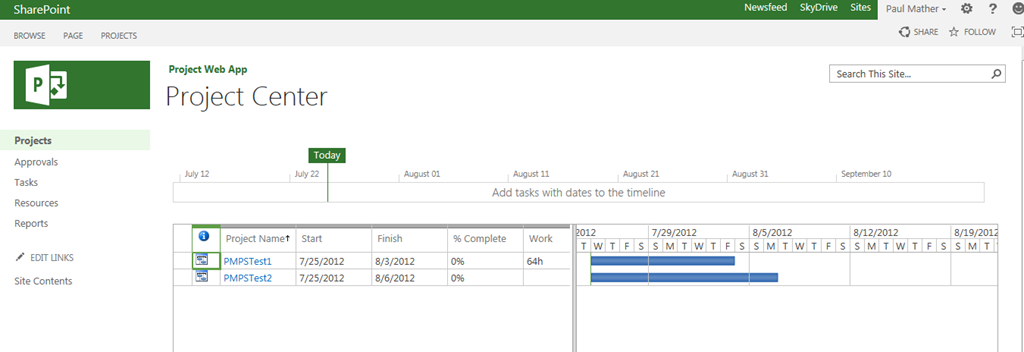
Firstly lets take a look at the project centre, here we can see the two Project Server projects as mentioned above.
Below are the two SharePoint 2013 sites created from the Project Site template:
Project Site template:

Project Sites:

Notice one task is assigned to Lee Mather – he is not currently a resource in Project Server.

Lets take a look at the Project Server Project Sites, we will use PMPSTest1 for this. As you can see below the tasks from the project plan do not appear in the Tasks list on the associated project site as this project is managed via PWA:


Notice the message stating that this project is managed by Project Server Project Web App.
Before we add any SharePoint sites to Project Server I just want to show the projects in the reporting tables from the ProjectServer database:

Now we will look at adding a SharePoint site, see the steps below:
Navigate to the Project Centre, click the Projects tab > Add SharePoint Sites:


Notice the three SharePoint sites, two are created from the project site template the there site is a team site with the Task list added.
Select PMSharePointTest1 and click Add:

Click Close
Below is a screen shot of the Project Server queue showing all of the successful jobs for adding this SharePoint site task list to Project Server:

Once the jobs have completed successfully, refresh the Project Centre and you will see the SharePoint site:

Clicking the PMSharePointTest1 project takes you to the Task list on the site:

Notice the quick launch on the site now has a Project Details link, this gives you access to the Project Detail pages for this project:

As this is not an enterprise Project Server project you cannot edit the tasks from the PDP.
Looking at the resource centre, you can see that Lee Mather has been automatically added as a resource to Project Server as he was assigned the task SPTask3 on the SharePoint task list:

Looking at the Resource assignments for my account, you will see that all tasks (from both enterprise projects and the SharePoint task list) are displayed:

The SharePoint task list project (PMSharePointTest1) will also be available in Project Professional 2013:

Project Professional synchronises with the SharePoint task list, new tasks can be added using Project Professional and these are synched back to the SharePoint task list on the PMSharePointTest1 site:

Saving the project will sync the tasks back to the Task list:


Running the same SQL query against the Reporting tables / views in the ProjectServer database now includes the tasks from the SharePoint site that was added. This enables reports to be easily created using Excel / SSRS etc.:

Notice the ProjectVisibilityMode column, for the SharePoint project site the value is 1, for enterprise projects the value is 0.
The data is also available in the Project Server OLAP cube, example below looking at the MSP Portfolio Analyser cube:

The SharePoint task list can be removed from Project Server using the normal delete enterprise object functionality – if you want to keep the SharePoint site do not check the box “Delete the connected SharePoint sites”!
The SharePoint task list can be converted to fully managed enterprise project using the active button on the Connected SharePoint Sites page:

After clicking Activate, the project will appear and function as a normal enterprise Project Server project and set the SharePoint task list to read only. Deactivating will set the project back to a SharePoint task list managed project.
Projects created in Project Server can also be deactivated and managed via the Task list.
This new functionality is great for organisations that want the visibility of lightweight projects in Project Server. This enables both types of projects, enterprise projects and task lists, to be visible in one central location and also make use of the full reporting capability of Project Server.
For more details see the links below:
http://technet.microsoft.com/en-us/library/ff631142(office.15).aspx#section5
http://technet.microsoft.com/en-us/library/ff631142(office.15).aspx#section10


SharePoint 2010 and 2013 WSP
Nice post here about creating a WSP for both 2010 and 2013. Or i should say upgrading your 2010 WSP to work on both
http://www.danlarson.com/sharepoint-2010-and-2013-wsp-compatibility/

via Buzz Blog http://paulbuzzblog.wordpress.com/2012/07/25/sharepoint-2010-and-2013-wsp/
 Paul is a an expert SharePoint and Project Server developer and is responsible for designing and implementing custom solutions on client systems using the latest SharePoint and .NET technologies.
Paul has extensive experience with SharePoint systems across all sizes of implementation, ranging from small to large farms and has an excellent understanding of all the elements of SharePoint. This article has been cross posted from speakingsilent.wordpress.com/ (original article) |

Project Online a new step forward
Just as always Project Online and Project Professional 2013 are out in the preview version. A lot of changes can still be made. I also want to point out that statements I make are mostly based on assumptions. As I don’t know what the final product will actually bring.
With the preview version coming out Microsoft also showed Project Online. So what is it? It is basically the office 365 version of Project Server. Project Server at the moment is only available as a Server product. For small – medium companies this might be too expensive to support.
With the coming of Project Online small-mid sized companies have the ability to benefit from almost all the capabilities of Project Server (Depending on the prize of course). Because it is based on office365 it a lot easier for small to mid sized companies to get there hands on it.

Project Online Home Page
This will open doors for these companies to start thinking about Enterprise Project Management (EPM). Meaning enterprise resource management, portfolio management en centralized project store for all the projects within the company.
Why would I still buy Project Server if Project Online is available? For me as it looks now in the preview version, Project Online can be categorized as a Project Server starter kit. It has a fare share of the functionalities and features of Project Server but has in its office365 environment somewhat limited configuration and development capabilities. Meaning branding, custom solutions, custom reports and probably more.
For bigger companies this might be a reason to go for a Project Server deployment instead of Project Online.
However I do think Project Online will be a great way for small to mid sized companies to experience Project. It is a great way for these companies to start managing Projects, Resources and Portfolios in a entirely different way.
If you want to test out Project Online you can do that here: http://www.microsoft.com/project/en-us/preview/default.aspx
I think Microsoft made a great leap forward with Project. I can’t wait to help new clients to set this up. Because don’t be fooled even Project Online needs a little bit of configuration before you can start using it for your company. Always remember the tool is easy, the process in your company around EPM is not.

via SpeakingSilent » Robin Kruithof http://speakingsilent.wordpress.com/2012/07/24/project-online-a-new-step-forward/
 I am Robin Kruithof. I am working at CXS in the Netherlands as a Microsoft Project Consultant. My passion lies in Project Management and everything in the Project Management domain.
This article has been cross posted from speakingsilent.wordpress.com/ (original article) |

Best source code plugin for wordpress and Live Writer
See here for the best source code plugin
http://richhewlett.com/wlwsourcecodeplugin/

via Buzz Blog http://paulbuzzblog.wordpress.com/2012/07/23/best-source-code-plugin-for-wordpress-and-live-writer/
|
Paul is a an expert SharePoint and Project Server developer and is responsible for designing and implementing custom solutions on client systems using the latest SharePoint and .NET technologies.
Paul has extensive experience with SharePoint systems across all sizes of implementation, ranging from small to large farms and has an excellent understanding of all the elements of SharePoint. This article has been cross posted from speakingsilent.wordpress.com/ (original article) |
Practice makes Perfect Pt 1 – Timeline #MSProject #ProjectServer #Office365
I am often asked “why should we upgrade from Project Professional 2007 to Project Professional 2010”. My answer would be “Why not” Project Professional 2010 has some new features/functions that can make a Project Managers live a lot easier.
In the first part of Practice makes Perfect I am going to talk about one of these new features; the Timeline.
“With the new office version Project Professional 2013 coming out in preview I used that to create most of the images. Remember this is still a preview version so things might change.”
The timeline is a new feature that allows a Project Manager to create a graphical presentation of his project. He can do this over his whole project or just select a few tasks he wants to show. This enable the Project Manager to use the timeline in presentations, documents or just put it against the wall.
The timeline looks something like this:

Click to enlarge.
Pretty neat i would say.
In the timeline you can do a couple of things.
You can change the format of all the task in the timeline. For instance you can color the most important task red. You can also change the format of the text styles to make something clear within the timeline.

Why would i use the timeline? Like I said it enables the Project Managers to create a easy to use view of the project in minutes. Easy to use in for example Word or PowerPoint. They way the data is presented it is also easier to read then a normal project Gant Chart.
There a numerous ways you can use this feature and I am not going sum up all of them. When you have access to Project Professional 2010 experiment with it. Trust me it will be worth your time.
So how do I use it?
There are two ways to you can add tasks into your timeline.
1. Right click your task and the one of the last commands you can give is “Add to Timeline”
2. Go to “Task Information” or double click your task and on the “General Tab” you will fine “Display on Timeline”.

Easy as that.
Enjoy your timeline!
 I am Robin Kruithof. I am working at CXS in the Netherlands as a Microsoft Project Consultant. My passion lies in Project Management and everything in the Project Management domain.
This article has been cross posted from speakingsilent.wordpress.com/ |

#ProjectServer 2013 online change permission mode #Office365 #PS2013 #SP2013
|
I am a Project Server and SharePoint consultant but my main focus currently is around Project Server.
I have been working with Project Server for nearly five years since 2007 for a Microsoft Gold Certified Partner in the UK, I have also been awared with the Microsoft Community Contributor Award 2011. I am also a certified Prince2 Practitioner. This article has been cross posted from pwmather.wordpress.com (original article) |
Quick post to detail the steps to change permission mode for Project Server 2013 online. The default permission mode is the SharePoint permission mode, to change this to Classic permission mode (Project Server mode) see the steps below:
Open PWA and click Admin > Project:

Select the PWA site and click Project Web App > Settings from the ribbon:

Check the Classic permission management radio button, specify an administrator and click OK.

Please note, switching between permission modes deletes all security related settings.


First Look at #ProjectServer online #Office365 #PS2013 #SP2013
|
I am a Project Server and SharePoint consultant but my main focus currently is around Project Server.
I have been working with Project Server for nearly five years since 2007 for a Microsoft Gold Certified Partner in the UK, I have also been awared with the Microsoft Community Contributor Award 2011. I am also a certified Prince2 Practitioner. This article has been cross posted from pwmather.wordpress.com (original article) |
As you are probably all aware the preview for next version of Office was released earlier this week. http://pwmather.wordpress.com/2012/07/16/projectserver-2013-preview-sharepoint2013-msproject/
In this post I will give a brief intro to the new version of Project Server 2013. I will cover the look and feel and highlight some of the new features. The screen shots from the post are from the Project online version as I haven’t got around to installing the on-premise version yet. For this example I have created a simple example project called PM Test Project 1.
Firstly lets take a look at the default PWA homepage:

The reminders web part has been updated with the cool new metro style “Track your work” web part to summarise your work. Clicking one of the icons takes you to that page to see the details, for example the Tasks page:

This page looks the same as it did in 2010.
The project centre now has the timeline view available:

You will also see a new button on the Projects tab, Add SharePoint sites:

When you click this button a new window will pop up populated with a list of the SharePoint sites based on the SharePoint Project Site template, below you can see the example site I created on the PWA site collection.

Once these SharePoint project sites are added they are visible in Project server but I will create a separate post for this soon!
The Project sites have nice new Project Summary web part where you can switch between the timeline or upcoming and late tasks:


All the project task are visible but not editable on the project site in the Tasks list:

There is also a notebook on the project site, this uses OneNote:

Project 2013:

The built in reports have been updated, take a look at the Project Overview report:

The report is editable, with new charts and tables etc.


The existing charts are all editable:

These are just a few examples of the new features in Project Server 2013 and Project 2013. I will be posting more details in the coming weeks.


#ProjectServer 2013 preview #SharePoint2013 #MSProject
|
I am a Project Server and SharePoint consultant but my main focus currently is around Project Server.
I have been working with Project Server for nearly five years since 2007 for a Microsoft Gold Certified Partner in the UK, I have also been awared with the Microsoft Community Contributor Award 2011. I am also a certified Prince2 Practitioner. This article has been cross posted from pwmather.wordpress.com (original article) |
The next version of Project Server is now available as a preview, see the links below:
Project Server 2013 preview:
http://technet.microsoft.com/en-gb/evalcenter/hh973403.aspx
Project Professional 2013 preview:
http://technet.microsoft.com/en-gb/evalcenter/hh973401.aspx
Other links:
http://technet.microsoft.com/en-gb/projectserver/fp123546
http://technet.microsoft.com/en-gb/projectserver/default
http://www.microsoft.com/project/en-gb/preview/


#ProjectServer Active Issues and Risks on PWA Reminders Web Part #PS2010 #SP2010 #SharePoint
|
I am a Project Server and SharePoint consultant but my main focus currently is around Project Server.
I have been working with Project Server for nearly five years since 2007 for a Microsoft Gold Certified Partner in the UK, I have also been awared with the Microsoft Community Contributor Award 2011. I am also a certified Prince2 Practitioner. This article has been cross posted from pwmather.wordpress.com (original article) |
The Project Server reminders web part contains key information relating to all projects that the logged on user is involved in. This includes new task assignments, timesheet information, pending approvals and active issues and risks assigned to the logged on user. This post focuses on the issues and risks count as I have seen a number of queries relating to the issues and risks not showing on the reminders web part.
Firstly I will detail where this web part gets the data from and then show working / non working examples. This web part reads data from the Project Server Reporting database, two stored procedures create the dataset for the web part then the code on the web part counts how many of those issues and risks are active. The status value is key to the issues and risks count on the reminders web part, this will be shown in the examples later on. In the image below you can see that I have 3 active risks and 2 active issues assigned to me on my test system:

Lets now take a look what the two stored procedures return from the Reporting database. Firstly I need to get my ResourceUID to pass into the stored procedures using the simple query below against the Reporting database:

The two stored procedures are MSP_WSS_ReadResourceIssues and MSP_WSS_ReadResourceRisks. These two stored procedures require a RES_UID value, in this example I will use my ResourceUID C5733575-2C0A-4B40-A367-E33B82A1CB33 as shown below:

As you can see I have 3 risks and 4 issues assigned to me. Notice on the PWA reminders web part it shows 3 active risks which matches the SQL dataset and 2 active issues which doesn’t match the SQL dataset. The issues SQL dataset returns four issues, 3 of which are active in the lists and one which is postponed.
For active issues and risks to appear on the reminders web part it is key that the Status value is (1) Active, notice that the 4th issue has a value of Active without the (1).
If I change the issue list settings for the PM Testing Assn project site so that the Status choice value includes (1) Active then edit the item, the reminders web part will correctly show 3 active issues.
The current Status choice values on the PM Testing Assn project site are shown below:

Once this choice list has been updated to include the correct Active value and the issues edited the SQL dataset will contain the correct values and therefore so will the reminders web part. The choice values updated to the correct values shown below:
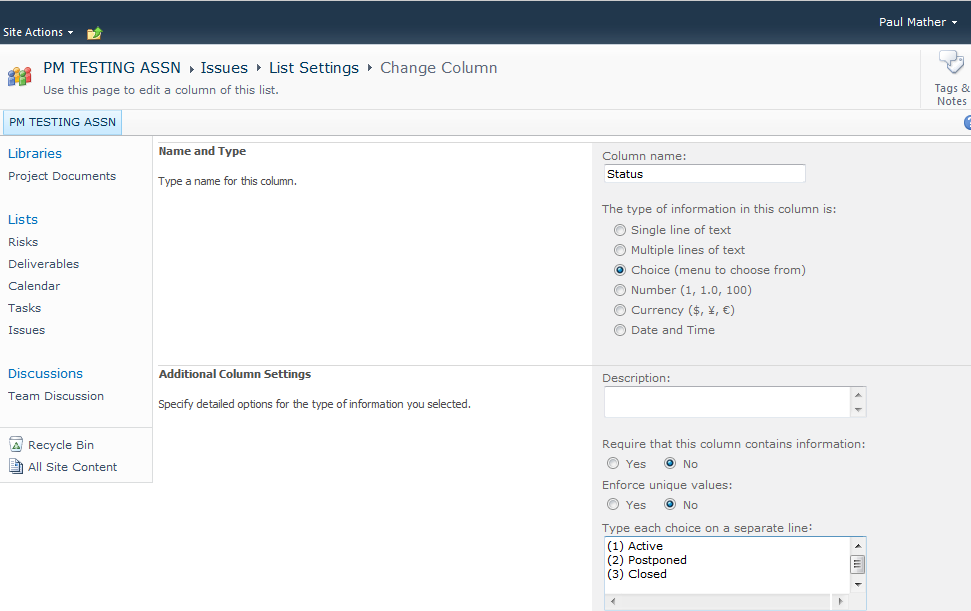
Now after editing the issue item the correct active Status value will appear:

The SQL stored procedures return the correct values after the Reporting (Project Sync) job has successfully completed in the Project Server queue:

Refreshing the PWA homepage now also shows the correct count on active issues and risks:

So the keys things to remember to make sure the reminders web part shows the correct counts for the active issues and risks are:
- ensure the Issues and Risks list default status values are not updated
- ensure the Reporting (Project Sync) jobs completed successfully
When updating the project site template it might be worth testing all default functionality, a useful project site smoke test can be found here:


Check all #SharePoint lists and libraries for specified column type in a site collection #SP2010 #PS2010 #ProjectServer #PowerShell
|
I am a Project Server and SharePoint consultant but my main focus currently is around Project Server.
I have been working with Project Server for nearly five years since 2007 for a Microsoft Gold Certified Partner in the UK, I have also been awared with the Microsoft Community Contributor Award 2011. I am also a certified Prince2 Practitioner. This article has been cross posted from pwmather.wordpress.com (original article) |
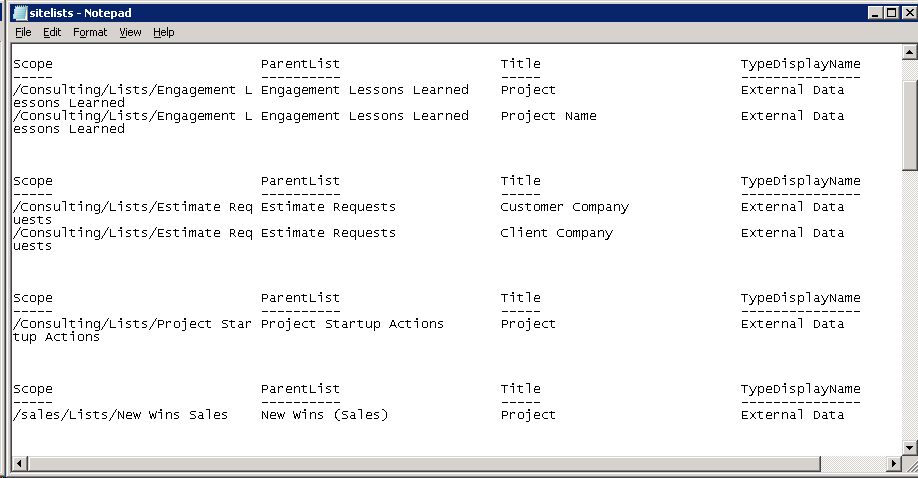
Recently we were carrying out an internal review of our SharePoint 2010 intranet system at CPS and needed to see where the BCS applications were used in the site collection on all sites. Rather than clicking on the list or library settings for each list / library to check for the External Data type on the column settings, I wrote a simple PowerShell script to check this.
The script is available from the Microsoft Script Center below:
http://gallery.technet.microsoft.com/scriptcenter/Check-all-lists-for-8689d3a9
To run the script, update the $siteCollection variable with the correct site collection URL and specify the column type, in our case this was External Data.
Once executed, the script will output the data to a text file called sitelists.txt. An example output can be seen below:


 SharePoint (and Project Server) Shenanigans
You must be logged in to post a comment.