Slipstream #Project Professional 2010 updates #MSProject #PS2010 #PS2007 #ProjectServer #MSOffice
Following on from my previous post Customising the Project Professional install, this post looks at slipstreaming the Project Professional 2010 updates into the Project install media. This simplifies the install as there is just one install file to run. This post will look at slipstreaming Service Pack 1 and the June 2011 Cumulative update into the Project 2010 install media. The same process applies for Project Professional 2007 but use the 2007 updates. This process also applies for other Microsoft Office applications with the relevant updates.
Firstly download the following updates:
- Project 2010 Service pack 1 – KB 2460052
- Project 2010 June 2011 Cumulative Update – KB 2536590
For the purpose of this post, I have both of the updates on the root of the C:\ drive, if you have the updates in a different location please update the commands to reflect the file location.
Create an Updates folder on the root of the C:\ drive
Open Command Prompt, navigate to the root of the C:\ drive and type the following command to extract Project 2010 SP1 to the new Updates folder:
project2010sp1-kb2460052-x86-fullfile-en-us.exe /extract:C:\Updates

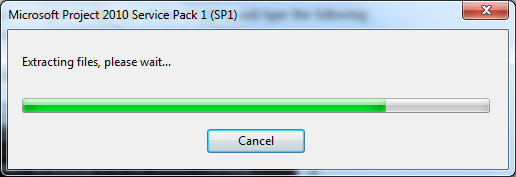
Press Enter and accept the license agreement in the pop up box, you will then see the files extracting dialog box
Once complete you will then see installation complete message:

Click OK then you will see the extracted files in the C:\Updates folder:

Copy the contents of the C:\Updates folder and paste the contents into the Updates folder in the install media.
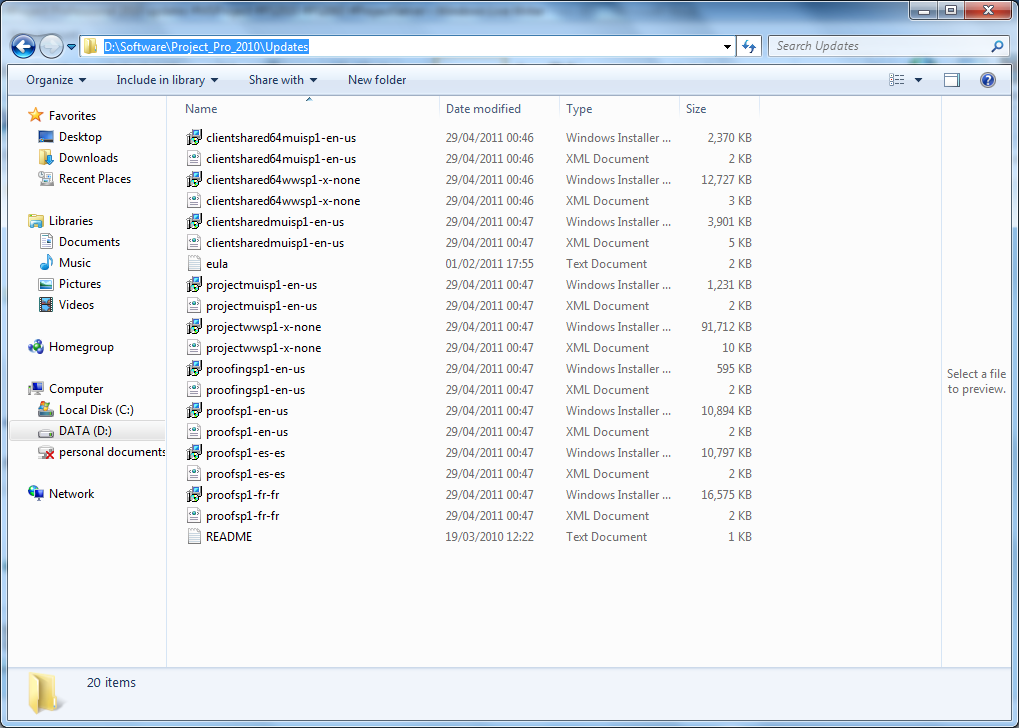
Once the files have been copied to the Updates folder in the install media for Project Professional 2010, delete all of the files from the C:\Updates folder so that you are ready to extract the Project 2010 June 2011 CU.
Open Command Prompt again and navigate to the root of the C:\ drive then type the following command to extract the Project 2010 June 2011 Cumulative Update to the Updates folder:
project2010-kb2536590-fullfile-x86-glb.exe /extract:C:\Updates
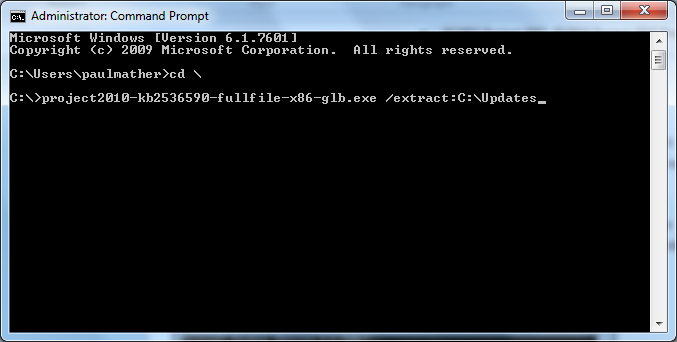
Press Enter and accept the license agreement in the pop up box, you will then see the files extracting dialog box appear followed by the installation complete message:

Click OK then you will see the extracted files in the C:\Updates folder:

Copy the contents of the C:\Updates folder and paste the contents into the Updates folder in the install media.
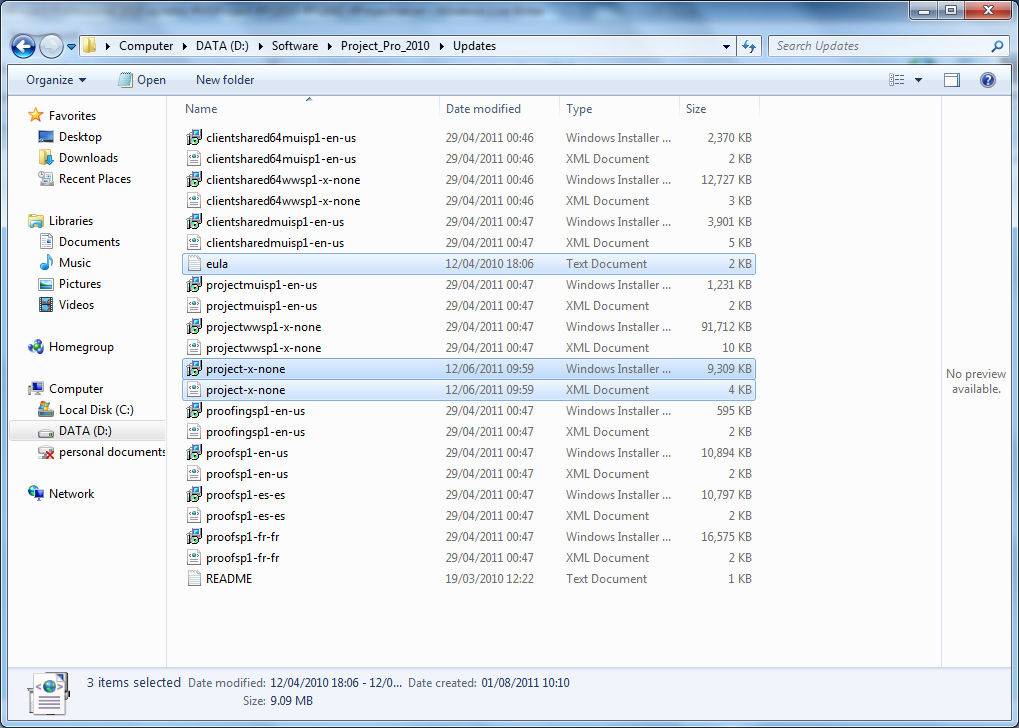
Now the updates have been extracted to the Updates folder in the installation media for Project Professional 2010, the updates will be applied when Project Professional 2010 is installed.

Further mobile app updates #iOS #Android #iPhone #SP2010 #SharePoint #PS2010 #ProjectServer #MSProject
Now that the Android release is out of the way, the application content can be updated.
New features in this content update:
- Location and date updates for Conferences, SharePoint Saturday’s and User Groups (UK)
- CodePlex Project video updates
- Minor link updates to SharePoint and Project Server RSS feeds including adding one of the site authors RSS feed for his new blog (Paul Mather: http://pwmather.wordpress.com)
If you have a blog, user group meeting or anything else you would like to add to the app, please get in contact.

Shenanigans community app now available on Android #in #PS2010 #ProjectServer #SP2010 #SharePoint #Android
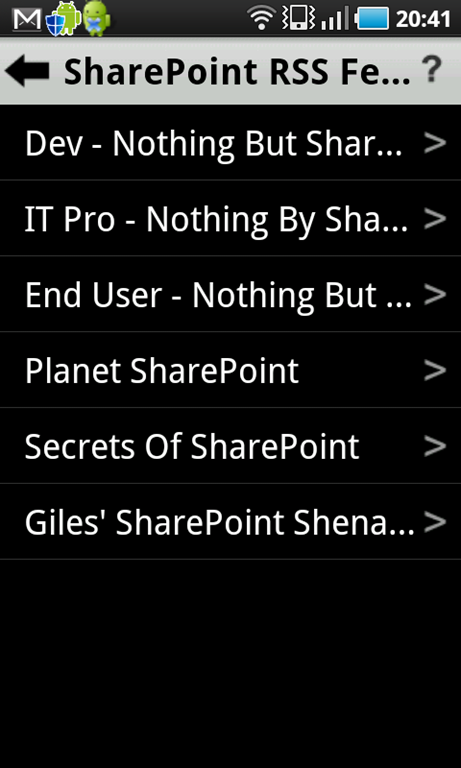
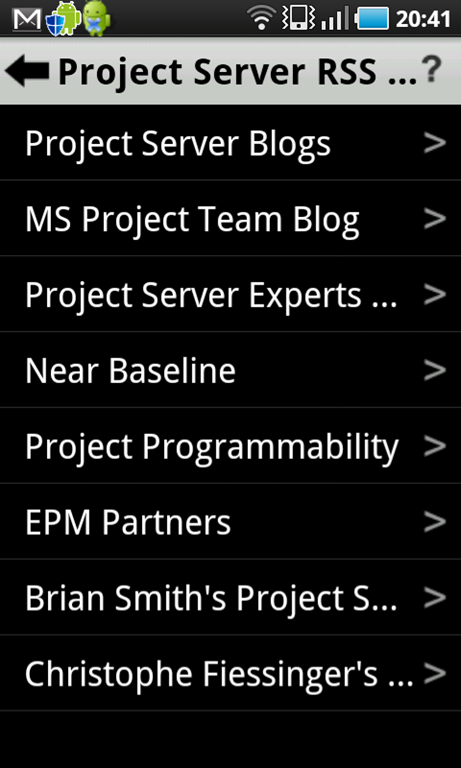
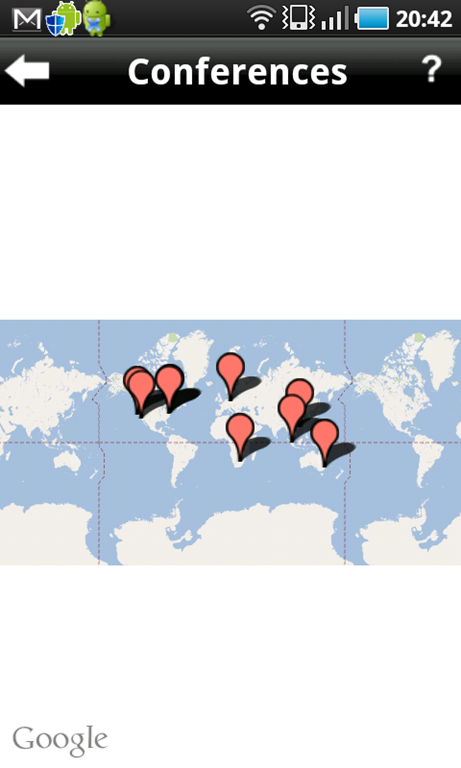
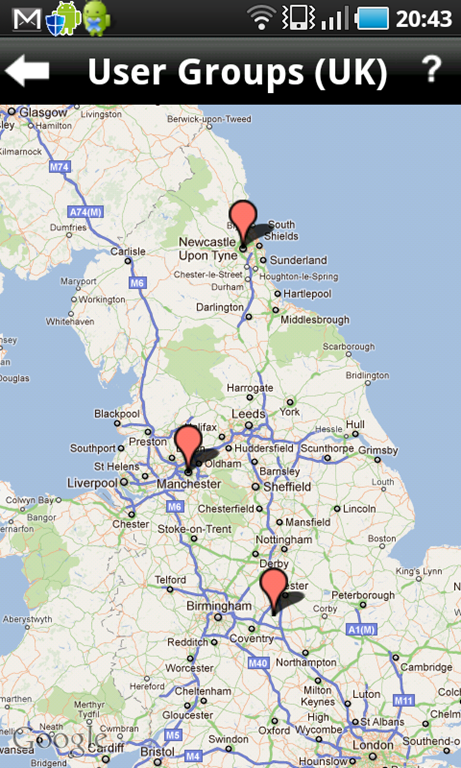
As promised last week, the SharePoint (and Project Server) Shenanigans mobile application is now available for Google’s phone OS on Android Market.
Features are exactly the same as the iPhone version of the application and all future updates to the app will be kept in sync via in-app updates for both iPhone and Android.
  |
Application features:
|


Application Name: SP & PS Shenanigans
Application Categories: Social
Search Keywords: SharePoint, Project Server, Giles Hamson, Shenanigans, Social
Screenshots:

 |
 |
 |
 |
 |
 |
 |
 |
 |

Further iPhone application updates #iphone #ipad #ios #SharePoint #SP2010 #MSProject #PS2010 #ProjectServer #in
Just a quick blog to say that I have updated the SharePoint (and Project Server) iPhone application today with the following content:
- About Me – Links to my profile, my company etc…
- SharePoint Conferences around the world – locations & dates
- SharePoint Saturday around the world – locations & dates
- Application Name: SharePoint (and Project Server) Shenanigans
Application Categories: Social Media, News
Search Keywords: SharePoint, Project Server, Giles Hamson, Shenanigans, RSS, Blog
Introducing a new #iPhone / #iPad application for the #SharePoint and #ProjectServer community #SP2010 #MSProject #in
  |
Application features:
|


As the community has been so kind to me, this is my way of giving something back and I welcome new feature suggestions and blogs to be added to the RSS feeds.

The user group meeting locations is currently only for the UK, but if anyone would like to add any further user group locations / dates, anywhere in the world. I will happily add them and they will be available on the application the following day.
|
Although the application is currently only available for the iOS platform, it will soon also be available for Android and potentially Windows Mobile 7 Please send feedback / suggestions via the contact form. |
 |
Application Name: SharePoint (and Project Server) Shenanigans
Application Categories: Social Media, News
Search Keywords: SharePoint, Project Server, Giles Hamson, Shenanigans, RSS, Blog
Screenshots:


Recreating the SharePoint 2010 State Service #SP2010 #SharePoint #PS2010 #MSProject #ProjectServer
My client was so eager to get SP1 and the June 2011 Cumulative Updates up and running on the Development and Test environments that on day one I was installing and testing the updates on my project.
What on earth was my clients requirement I hear ask? couldn’t they wait?
Well the end users are heavy Linux users and the requirement for Timesheet data entry within Firefox is v.strong. As a result, testing SP1 outside of the beta that we had already tested was top priority.
Of course, a few days later the June 2011 Cumulative Update was re-released and it is widely known that the State Service among other things can go wrong.
Looking into it further and the State Service cannot be created in the usual method (clicking the new button in the Managed Service section of Central Administration).
So PowerShell to the rescue:
$StateServiceDB = "SP2010_StateService"
$GetSPStateServiceApplication = Get-SPStateServiceApplication

If ($GetSPStateServiceApplication -eq $Null)
{
   Write-Host -ForegroundColor White "- Creating State Service Application..."
   New-SPStateServiceDatabase -Name $StateServiceDB | Out-Null
   New-SPStateServiceApplication -Name "State Service Application"
 -Database $StateServiceDB | Out-Null
   Get-SPStateServiceDatabase | Initialize-SPStateServiceDatabase | Out-Null
   Write-Host -ForegroundColor White " - Creating State Service
 Application Proxy..."
   Get-SPStateServiceApplication | New-SPStateServiceApplicationProxy
 -Name "State Service Application Proxy" -DefaultProxyGroup | Out-Null
   Write-Host -ForegroundColor White "- Done creating State Service
 Application."
}
Else
{
   Write-Host -ForegroundColor White "- State Service Application
 already exists."
}
Security Validation Issue – Form Services issue with SP1+June 2011 CU (Release 2) #in #SP2010 #SharePoint #MSProject #ProjectServer
We are testing Service Pack 1 heavily in my project that I have talked about on this blog many times.
One of the features of our implementation is a number of developed InfoPath forms. We found one issue previously that required a hotfix and it looks like SP1 and June 2011 CU (Release 2) has introduced another.
My colleague Paul Busby has mentioned it here:
and another user has also confirmed the issue.
I shall be sending the details below to Microsoft through our partner support and hopefully we can get a resolution.
Scenario:
- Form Services
- Administrator Approved Form
- Server Version: 14.0.6106.5002 (Office 2010 SP1 + June 2011 CU – Release 2)
- Client Version: 14.0.6023.1000 (Office 2010 SP1)
- NB: June 2011 Cumulative Update does not include updates for InfoPath 2010
- Microsoft June 2011 Cumulative Update for Office 2010 Client Applications – KB2259686: http://support.microsoft.com/kb/2259686/en-us
The form has two views:
- View one has a people picker
- View two is blank
The form is uploaded via Central Administration and activated to a site collection
A form library is created and the associated content type is attached
Upon creating a new form, the form loads

When the user switches views in the form, a Security Validation Error occurs:

Further Details:
- We have discovered that it appears to happen when switching to or from a view that contains a people picker field.
- Turning off security validation, allows the form to continue to work, but this is not something we want to go live with
- This issue has been found on a client DEV and TEST environment as well as a newly installed RTM machine upgraded to SP1 + June 2011 CU Release 2
SharePoint 2010 Log Details (specific details in red):
07/20/2011 13:54:03.85 w3wp.exe (0x10CC) 0x11BC SharePoint Foundation Monitoring nasq Medium Entering monitored scope (Request (POST:http://vm482:80/_layouts/FormServer.aspx?XsnLocation=http://vm482/FormServerTemplates/SP1SecurityValidationTest_Published.xsn
&SaveLocation=http%3A%2F%2Fvm482%2FSP1SecurityValidationTest&ClientInstalled=true&Source=http%3A%2F%2Fvm482%2FSP1SecurityValidationTest%2FForms%2FAllItems%2Easpx&DefaultItemOpen=1))
07/20/2011 13:54:03.85 w3wp.exe (0x10CC) 0x11BC SharePoint Foundation Logging Correlation Data xmnv Medium Name=Request (POST:http://vm482:80/_layouts/FormServer.aspx?XsnLocation=http://vm482/FormServerTemplates/SP1SecurityValidationTest_Published.xsn
&SaveLocation=http%3A%2F%2Fvm482%2FSP1SecurityValidationTest&ClientInstalled=true&Source=http%3A%2F%2Fvm482%2FSP1SecurityValidationTest%2FForms%2FAllItems%2Easpx&DefaultItemOpen=1) 5c0ca3e0-a782-4691-9a79-b2e163e3f0e9
07/20/2011 13:54:03.85 w3wp.exe (0x10CC) 0x11BC SharePoint Foundation Logging Correlation Data xmnv Medium Site=/ 5c0ca3e0-a782-4691-9a79-b2e163e3f0e9
07/20/2011 13:54:03.91 w3wp.exe (0x10CC) 0x11BC SharePoint Foundation Web Controls cm8z Medium Failed to get SPGroupName from GroupID. Error Message: Group cannot be found. Callstack: at Microsoft.SharePoint.SPGroupCollection.GetByID(Int32 id) at Microsoft.SharePoint.WebControls.PeopleEditor.set_SharePointGroupID(Int32 value). 5c0ca3e0-a782-4691-9a79-b2e163e3f0e9
07/20/2011 13:54:03.91 w3wp.exe (0x10CC) 0x11BC SharePoint Foundation General 8kh7 High The security validation for this page is invalid. Click Back in your Web browser, refresh the page, and try your operation again. 5c0ca3e0-a782-4691-9a79-b2e163e3f0e9
07/20/2011 13:54:03.91 w3wp.exe (0x10CC) 0x11BC SharePoint Foundation Runtime tkau Unexpected System.Runtime.InteropServices.COMException: The security validation for this page is invalid. Click Back in your Web browser, refresh the page, and try your operation again. at Microsoft.SharePoint.Library.SPRequestInternalClass.ValidateFormDigest(String bstrUrl, String bstrListName) at Microsoft.SharePoint.Library.SPRequest.ValidateFormDigest(String bstrUrl, String bstrListName) 5c0ca3e0-a782-4691-9a79-b2e163e3f0e9
07/20/2011 13:54:03.91 w3wp.exe (0x10CC) 0x11BC SharePoint Foundation Monitoring b4ly Medium Leaving Monitored Scope (Request (POST:http://vm482:80/_layouts/FormServer.aspx?XsnLocation=http://vm482/FormServerTemplates/SP1SecurityValidationTest_Published.xsn
&SaveLocation=http%3A%2F%2Fvm482%2FSP1SecurityValidationTest&ClientInstalled=true&Source=http%3A%2F%2Fvm482%2FSP1SecurityValidationTest%2FForms%2FAllItems%2Easpx&DefaultItemOpen=1)). Execution Time=66.2620528586734 5c0ca3e0-a782-4691-9a79-b2e163e3f0e9

#ProjectServer 2010 PSI data to a text file using #PowerShell #PS2010 #Project
I recently looked into accessing the Project Server PSI via PowerShell, luckily I came across this MSDN article that helped: http://msdn.microsoft.com/en-us/library/gg607685.aspx#pj14_GettingStartedTa_PowerShell. I needed to get the data into a pipe delimited text file without using compiled code (I’m not a developer!). I have done this before with T-SQL and SSIS but I wanted to try something different. For the purpose of this blog article of have edited the example shown in the MSDN article. The PowerShell script is below:
$pwaUrl = "http://vm353/pwa"
$svcProjectUrl = $pwaUrl + "/_vti_bin/PSI/Project.asmx?wsdl"
$c = Get-Credential
$svcProjectProxy = New-WebServiceProxy -uri $svcProjectUrl -credential $c
$svcProjectProxy.ReadProjectList().Project | Select Proj_name, Proj_UID, Proj_Type `
| Export-CSV C:\projects.txt -Delimiter "|"
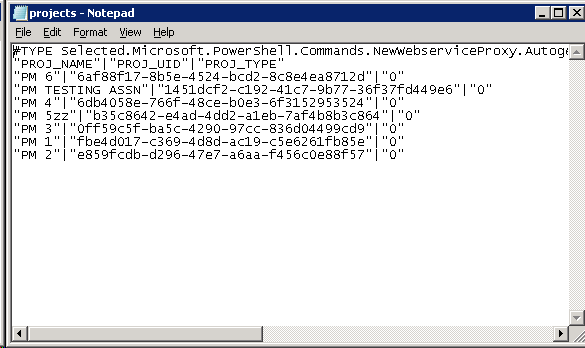
This script will export out a list of Project names, Proj UIDs and the Project Types to the C drive in a text file called projects.txt using the pipe delimiter. Screen shots below show the script and the output.
Script:

Output:
This is a very simple example but provides a no code solution to access Project Server data via the PSI.

Manually adding users to Project Workspace / Project Site in #ProjectServer #PS2010 #PS2007 #EPM
This post will detail the errors seen when trying to add or edit items in a Project Site / Project Workspace in Project Server when adding users manually to a Project Site when they don’t have the correct permission in Project Server. For the purpose of this guide I will base this on Project Server 2010 but the same applies for Project Server 2007.
A bit on the background information to start with so that it makes it clear later on in the post why you see these errors. Project Server has its own permission model that works differently to the SharePoint permission model. Users are added to Project Server via the PWA > Server Settings > Manage Users interface and not the SharePoint Site Actions > Site Permissions interface. This is because users will be added to the PWA site based on their Project Server permissions, to an extent the same can be said for the Project Sites. Although Project Sites appear and function the same as a normal SharePoint site, certain lists / document libraries work very differently to standard SharePoint lists / libraries. The Project Documents library, Risks list and Issues list link back to Project Server so therefore when editing / adding items, firstly the SharePoint permissions will be checked, then the Project Server permissions will be checked. If the user doesn’t have the correct permissions in Project Server, then they will see errors, even if they have full control on the Project Site. Each error is shown below.
In this example I have added a user directly to the Project Site, the user has Full Control of this Project Site, also this user does not have any access to PWA.
Project Documents:
When adding a document to the Project Documents library the user will see this error pop up once they click OK to add the document:

When they click, “Go back to Site” they will see that document has still been uploaded:
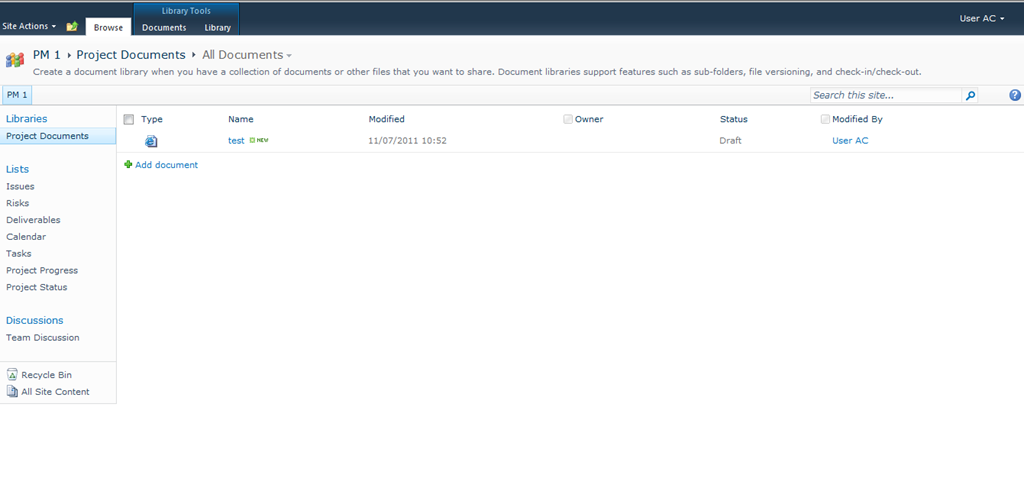
The error is thrown when the Project Server permissions are validated. The error below can be seen in the SharePoint ULS logs:
System.Web.Services.Protocols.SoapException: ProjectServerError(s) LastError=GeneralSecurityAccessDenied Instructions: Pass this into PSClientError constructore to access all error information at Microsoft.Office.Project.Server.WebServiceProxy.Security.CheckUserProjectPermission(Guid projectUid, Guid categoryPermissionUid) at Microsoft.Office.Project.PWA.CustomFieldWebControls.CustomPWALinkField.OnLoad(EventArgs e)
As you can see from the error above, it fails when checking the Custom PWA Link field as this is used to link the Document back to a task in the Project. As this user doesn’t have access to Project Server the error is thrown.
Risks and Issues lists:
Users will not be able to create an item on the risks or issues list if they do not have the correct permissions in Project Server, they will see the error below when clicking New Item:

The error below can be seen in the SharePoint ULS logs:
System.Web.Services.Protocols.SoapException: ProjectServerError(s) LastError=GeneralSecurityAccessDenied Instructions: Pass this into PSClientError constructore to access all error information at Microsoft.Office.Project.Server.WebServiceProxy.Security.CheckUserProjectPermission(Guid projectUid, Guid categoryPermissionUid) at Microsoft.Office.Project.PWA.CustomFieldWebControls.CustomPWALinkField.OnLoad(EventArgs e)
As a minimum, users will need permission in Project Server to use these lists, I would also recommend that you let Project Server control the users permissions to the Project Sites. To do this check the box “…automatically synchronize Project Web App users with Project Sites when they are created…”, on the PWA > Server Settings > Project Site Provisioning Settings page.

This will synch the users to the Project Site when the Project is published, it will add users to the Project Sites based on their Project Server permissions and therefore less of an administration overhead. The permission the users get on the Project Site can be seen below:
- Project managers who have published a project or who have Save Project permissions on a project are added to the Project Managers (Microsoft Project Server) site group.
- Team members with assignments in a project are added to the Team members (Microsoft Project Server) site group.
- Other Project Server users who have View Project Site permission on a project are added to the Readers (Microsoft Project Server) site group.
Hopefully that explains why you see these errors on the Project Sites.

How to check the SharePoint 2010 and Project Server 2010 service pack / patch level #PS2010 #ProjectServer #SharePoint #SP2010
This article will show how to check the farm version for SharePoint Foundation 2010, SharePoint Server 2010 and Project Server 2010.
The farm patch level can be check in the Central Administration site, click “Upgrade and Migration” then “Check Product and Patch Installation Status”

The patch level of all farm components will be detailed here, as you can see below, Project Server is listed at the bottom:

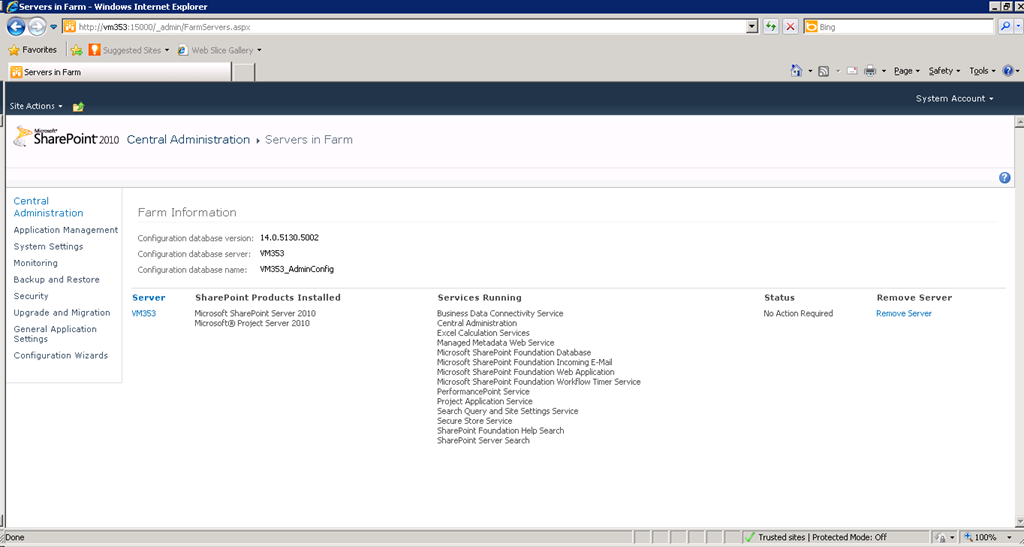
The farm configuration database version can also be checked on the “Manage Servers in this farm” page:
You can also check the SQL databases directly just running the query below:
select version
, ID
, UserName
, TimeStamp
from versions
Or if you want to see everything:
Select * from versions
This query can be executed against most of the SharePoint 2010 databases and all of the Project Server 2010 PWA databases. Worth noting is that not all SharePoint databases have a versions table, also not all of the versions tables get updated with every update, it usually depends if there is a schema update.


 SharePoint (and Project Server) Shenanigans
You must be logged in to post a comment.