#ProjectServer #SSRS Report with multivalued parameters #SQL #PS2010 #SP2010
   I am a Project Server and SharePoint consultant but my main focus currently is around Project Server.
I have been working with Project Server for nearly five years since 2007 for a Microsoft Gold Certified Partner in the UK, I have also been awared with the Microsoft Community Contributor Award 2011. I am also a certified Prince2 Practitioner. This article has been cross posted from pwmather.wordpress.com (original article) |
A quick blog post to highlight the use of one of the Project Server Reporting database functions to resolve an issue when using an SSRS multi value parameter.
There are several methods to get multi value parameters working in SQL Server Reporting Services (SSRS) including dataset filters, joining parameters and custom SQL functions – other blogs / forum posts detail these. This post demonstrates using a function that is available in the Project Server Reporting database. The function is called MSP_FN_Utility_ConvertStringListToTable. An example SQL Stored Procedure that will allow multi values can be seen below:
CREATE PROCEDURE [dbo].[SP_ProjectData] (
@ProjUID NVARCHAR (max)
)AS
BEGIN
select P.ProjectName
, T.TaskName
from MSP_EPMProject_UserView P
INNER JOIN MSP_EPMTask_UserView T
ON P.ProjectUID = T.ProjectUID
INNER JOIN MSP_FN_Utility_ConvertStringListToTable (@ProjUID) AS PU
On P.ProjectUID IS NULL or P.ProjectUID like PU.TokenVal
END
Create the SQL query as normal but instead of using a where clause to filter the Project UIDs join on to the function as shown above.


SharePoint Security Bulletin – Critical
Microsoft Security Bulletin MS13-024 – Critical
Vulnerabilities in SharePoint Could Allow Elevation of Privilege (2780176)
Published: Tuesday, March 12, 2013
Executive Summary
This security update resolves four privately reported vulnerabilities in Microsoft SharePoint and Microsoft SharePoint Foundation. The most severe vulnerabilities could allow elevation of privilege if a user clicks a specially crafted URL that takes the user to a targeted SharePoint site.
This security update is rated Critical for all supported editions of Microsoft SharePoint Server 2010 and rated Important for all supported editions of Microsoft SharePoint Foundation 2010. For more information, see the subsection, Affected and Non-Affected Software, in this section.
The security update addresses the vulnerabilities correcting the way that Microsoft SharePoint Server validates URLs and user input. For more information about the vulnerabilities, see the Frequently Asked Questions (FAQ) subsection for the specific vulnerability entry under the next section, Vulnerability Information.
http://technet.microsoft.com/en-us/security/bulletin/ms13-024

SP2010, #PerformancePoint and Kerberos
I was recently involved in getting PerfomancePoint and the “Per User Identity” configuration working for a client running SharePoint 2010. The same configuration still holds true for SharePoint 2013, but for 2013 both PerformancePoint and Excel Services now introduce the new “EffectiveUserName” feature, which should make life a load easier.
In the world of SharePoint /PerformancePoint 2010 if you want to build an MI dashboard that shows user specific information in the reports the only way to do this effectively is to use the “Per-User Identity” option in the Data Source Connection setting, which in turn involves setting up Kerberos and specifically constrained delegation, in this article I will cover the broad steps needed.
Kerberos on Web App.
Firstly make sure that Kerberos is running on the Web App that will be hosting your PerformancePoint content, the best way to check this is in the Windows Security log, filter on 4624 events and find a logon event, make sure its a type 3 (Network) and the Process is Kerberos.

Kerberos on Target.
Make sure you have the correct SPNs registered against your target, typically with PerformancePoint this will be an SSAS cube, use SetSPN –S MSOLAPSvc.3/ServerName DomainName\SSASDomainAccount to create the SPNs, these will be key, so take your time and make sure you get them right.
Claims to Windows Token Service
PerformancePoint (along with Excel and Visio Services) relies on the C2WTS for Protocol Transition, so this must be running and configured correctly.
I would recommend running the C2WTS as a separate managed account, this account needs some specific requirements (local administrator, Logon as a service, Act as part of the operating system and Impersonate a client after authentication, set the last 3 in local security policy.)
If the C2WTS is not happy you will probably see something like the error below logged in the Windows Application log when trying to connect.

You also need to register a manual SPN for the C2TWS, something like SetSPN –S SP/C2WTS DomainName\C2WTSDomainAccount, this will allow the “delegation” tab on the user account domain object to become available.
Constrained Delegation.
This is the tricky part to get working, basically we are saying that “object A” is allowed to delegate to “service A” only in, our case it will be “object A & object B and object C”, are allowed to delegate to “Service A” in fact all the objects in the delegation chain, so to allow delegation we open our user object in AD, go to the “Delegation” tab, select “Trust this user for delegation to the specified services only” (This is setting constrained delegation)–> “Use any authentication protocol” (This is allowing protocol transition).
Use the Add… button to find the service account for the SSAS Domain account mentioned above and select the Service Type you setup earlier.
You will probably have to perform this for your Web Application account, C2WTS account, PerformancePoint account and any other managed service account that is involved, once finished each account should have a setting like this
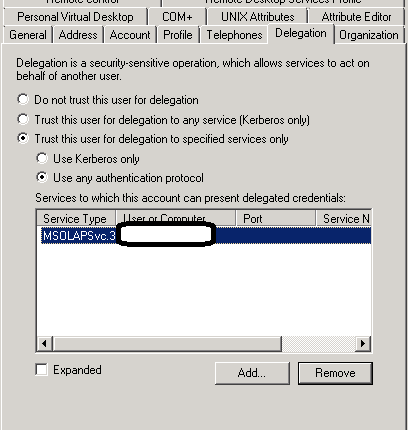
Remember that if the Delegation tab is not available on the user object you have to create a manual SPN.
If your data connection still refuses to connect with the “Per-User Identity setting”, have another look at the eventlog again and look for this error.

This probably means you still have an SPN missing or not configured correctly, the best way to deal with this is to install Network Monitor then run a trace while trying to connect and filter on the ‘KerberosV5’ events, and you are looking for any Kerberos error codes most likely you will see some kind of PRINCIPLE_UNKNOWN error being reported, normally associated with a user name or service account that has been missed in the constrained delegation settings.
Good luck and Happy SharePointing
Follow @NeilKing41
SharePoint Designer 2013 workflow action “Call HTTP Web Service”
Part 1
In this first section we will start creating our SharePoint Designer 2013 workflow. Our focus here is the “Call HTTP Web Service” action. We will be using and Ebay web service for this example. The response from the web service is in JSON (See image below). The “Call HTTP Web Service” workflow action would be useless without the new “Dictionary” workflow action.

Part 2:
In this section we will be taking the workflow a bit further.
1. We will extract the “Title” and “DealURL” data from the JSON response.
2. We will then create and entry in the WebServiceList for each node in our JSON response ( 7 in total )

Reference:

Microsoft releases Project Online

Last week Microsoft released Project Online. For me it has been a long wait as I have been playing around with Project Online since the preview version was available in July 2012.
So for people that don’t know Project Online it is basically the cloud version of Project Server. You now have the ability to provision it in the cloud and use it on a per user basis. In my opinion this will make Project Server functionality a lot more accessible and flexible to small and medium sized businesses.
I can image that a lot of businesses in the past didn’t choose for a PPM Solution like Project Server or any other PPM solution because of cost and effort that is needed to implement such a solution. Now with a few click of a button you have your own Project Online environment to support your projects. The per user basis of Project Online gives an organization a lot of flexibility in the use of the PPM solution.
So why should you and your business get excited about Project Online?
Project Online offers a centralized place for all your projects, a centralized resource pool to determine demand vs. capacity within your organization, it offers portfolio management, on demand reports and the list goes on. All you need to guide your projects to success.
In my opinion Project Online is a great step by Microsoft to make a PPM solution accessible to smaller markets. But it doesn’t stop there, it is also a great way for a bigger organizations to support program’s or specific departments. But don’t take my word for it, try it yourself http://office.microsoft.com/en-us/project/.
I am looking forward to see how the adaptation of Project Online will be in the coming months and the responds of the business that are using it.

via SpeakingSilent » Robin Kruithof http://speakingsilent.wordpress.com/2013/03/05/microsoft-releases-project-online/
 I am Robin Kruithof. I am working at CXS in the Netherlands as a Microsoft Project Consultant. My passion lies in Project Management and everything in the Project Management domain.
This article has been cross posted from speakingsilent.wordpress.com/ (original article) |

#ProjectServer #PowerView report in #Excel 2013 #PS2010 #PS2013 #Office2013
|
I am a Project Server and SharePoint consultant but my main focus currently is around Project Server.
I have been working with Project Server for nearly five years since 2007 for a Microsoft Gold Certified Partner in the UK, I have also been awared with the Microsoft Community Contributor Award 2011. I am also a certified Prince2 Practitioner. This article has been cross posted from pwmather.wordpress.com (original article) |
This post will take a brief look at creating a map view of Project Server data – this does assume you tag your projects with a location!
For the purpose of this post I will use the example Excel file shown below – this pulls data from one of my test Project Server PWA instances, hence the project names!

In Excel 2013, click Insert > Power View Reports:

You will now see a Power View report:

To create a map with the projects plotted in the correct location by cost, see the steps below.
On the design tab, click Map and you will see the following:

Now click the map and modify the Power View fields shown below:

For this example, add ProjectCost to the size property, add Project Locations to the Locations property and set the colour property to ProjectName:

Increase the size of the map and add a title:

You can hover over the data circles and a tooltip will appear with the project details:

The data can be refreshed and the map updates.
A quick and simple report to show projects by location.


Getting the logged on user name using the client object model
If you want to use the SharePoint 2010 client object model you can use the code below:
ExecuteOrDelayUntilScriptLoaded(getWebUserData, “sp.js“);
var context = null;
var web = null;
var currentUser = null;
function getWebUserData() {
context = new SP.ClientContext.get_current();
web = context.get_web();
currentUser = web.get_currentUser();
currentUser.retrieve();
context.load(web);
context.executeQueryAsync(Function.createDelegate(this, this.onSuccessMethod),
Function.createDelegate(this, this.onFailureMethod));
}
function onSuccessMethod(sender, args) {
var userObject = web.get_currentUser();
var UserTitle = userObject.get_title();
alert(UserTitle);
}
function onFailureMethod(sender, args) {
alert(‘request failed ‘);
}
Here is a video and a simple way to test it.
Enable Mobile Browser View for SharePoint Online public site
So you upgraded to SharePoint Online 2013. If you are like me, you might have been looking on your SharePoint Online public site for the mobile “Contemporary view“. However, you will NOT find it. “Manage Site Feature” does not exist in a public site.
You can use the mobile Contemporary view for your SharePoint Online private site collection. First you will need to enable the feature via Site Settings > Manage Site Features > Mobile Browser View.
The right image is the standard view. The image on the left is the mobile contemporary view.


#ProjectServer and #SharePoint 2010 / 2013 February 2013 Cumulative Update #PS2010 #SP2010 #PS2013 #SP2013 #MSProject
|
I am a Project Server and SharePoint consultant but my main focus currently is around Project Server.
I have been working with Project Server for nearly five years since 2007 for a Microsoft Gold Certified Partner in the UK, I have also been awared with the Microsoft Community Contributor Award 2011. I am also a certified Prince2 Practitioner. This article has been cross posted from pwmather.wordpress.com (original article) |
Now that the first CU’s for 2013 are available, I will include both 2010 and 2013 updates in the future posts.
The Office 2013 February 2013 Cumulative Updates are now available, please see the links below:
http://support.microsoft.com/kb/2802843
Project Server 2013 Server Roll up package February 2013 CU (Recommended):
(Delayed)
Project Server 2013 February 2013 CU (Included in the Server Roll up package):
(Delayed)
Project 2013 February 2013 CU:
http://support.microsoft.com/kb/2738031
The Office 2010 February 2013 Cumulative Updates are now available, please see the links below:
http://support.microsoft.com/kb/2800779
Project Server 2010 Server Roll up package February 2013 CU (Recommended):
http://support.microsoft.com/kb/2767794
Project Server 2010 February 2013 CU (Included in the Server Roll up package):
http://support.microsoft.com/kb/2760772
Project 2010 February 2013 CU:
http://support.microsoft.com/kb/2760778
Remember SP1 is a pre-requisite for the Office 2010 February 2013 CUs.
For more details please see:
http://blogs.technet.com/b/projectsupport/archive/2013/02/14/microsoft-project-server-2007-2010-and-2013-february-2013-cu-announcement.aspx
As always, test these updates on a replica test environment before deploying to production


SP2010 Corrupt BlobCache
Just a quick entry.
While running a client health check I spotted an error in the Event log that I have never seen before.
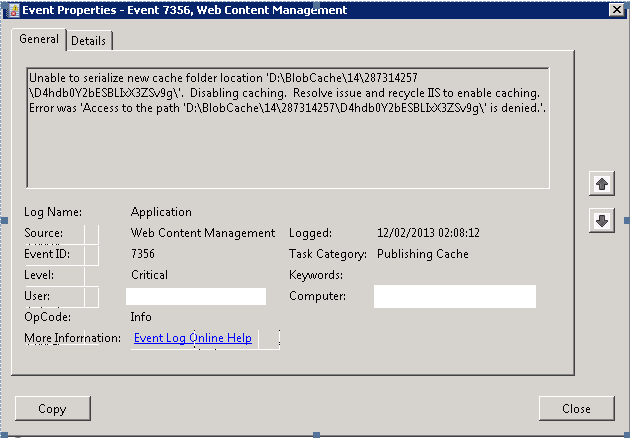
Googling the Event ID and text didn’t help as I couldn’t find anything online about this.
Clearly the BlobCache on this server had become corrupted somehow, upon closer inspection the folder \287314257 was missing from the location D:\BlobCache\14, hence the error.
The fix was to disable the BlobCache from the web.config, do an IIS Reset and delete the folder D:\BlobCache then re-enable the Blobcache.


 SharePoint (and Project Server) Shenanigans
You must be logged in to post a comment.